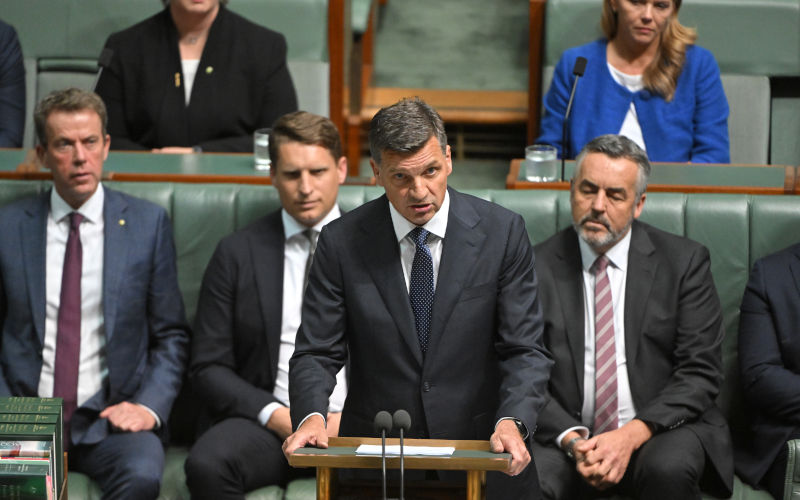
Angus Taylor’s budget reply speech may appeal to One Nation supporters, but it doesn’t provide credible answers to the nation’s problems.
For as long as most of us can remember the Liberals have cultivated the perception that they are the better economic managers. But since Labor took power four years ago, the lack of policy by the Liberals has meant that the assumption that they can be trusted to manage the economy better no longer holds.
Consequently, the budget reply speech by the Liberal’s new leader, Angus Taylor, was more than usually awaited. This was an important opportunity for Taylor to set a direction and economic strategy for the Liberals that will seize back votes, especially from One Nation, and make the Liberals competitive again electorally.
The three major policy differences between the Liberals and Labor that Taylor concentrated on were:
- Repeal of the government’s proposed changes to the capital gains tax, negative gearing, and taxation of trusts, and instead commit to indexation of the tax scales so that for the typical worker their average tax rate would never change.
- Reducing migration numbers and tying the number of new migrants to the number of new homes built.
- Rejecting Labor’s net zero policies and (allegedly) get cheaper energy by digging coal, drilling oil, and nuclear.
Liberal tax policies
The centrepiece of Taylor’s speech was his promise that a future Coalition Government would repeal Labor’s proposed changes to the capital gains tax, negative gearing and the taxation of trusts.
According to Taylor these “higher taxes aren’t economic reform. They’re an assault on aspiration”.
What Taylor totally ignored is that, as Aruna Sathanapally and Matthew Bowes wrote in P&I (15 May), Australia’s personal income tax system is imbalanced as it “leaves taxes on wages and salaries to do the heavy lifting, while granting generous concessions to income from wealth”.
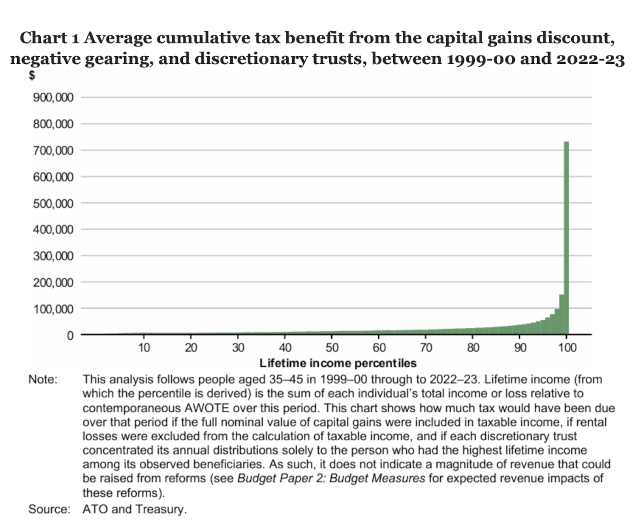
As Treasury analysis shows, the combination of these three tax concessions tax concessions was worth more than $700,000 over their working life for the top 1 per cent of taxpayers by life-time income. On the other hand, the 70 per cent of taxpayers who are in the lowest income ranges gain practically nothing from these concessions (see Chart 1).
Taylor also wants us to believe that the gradual removal of these tax concessions will harm investment.
It is true that Treasury modelling suggests that housing prices will grow by around 2 per cent less over a couple of years relative to no policy change, and this will have a modest impact on housing supply, with the increase in supply over the next ten years forecast to be around 35,000 dwellings fewer compared to no policy change. But exempting new builds from Labor’s tax changes will limit how much these tax changes impact on supply. At present property investors are five times more likely to invest in existing properties than to build new ones, and they now have an incentive to switch to investing in new dwellings.
Furthermore, the forecast of 35,000 fewer new dwellings in response to Labor’s tax changes will be more than offset by the budget providing another $2 billion in infrastructure support that will result in another 65,000 homes over ten years. Also proposed changes to regulatory approvals should further increase the supply of housing.
Treasury estimates that in combination these reforms will enable an extra 75,000 Australians to gain home ownership than otherwise over the next decade.
Most importantly, if we want to increase productivity and economic growth, then we need to switch investment towards supporting innovation which generates an income stream. Or as Chalmers says we need to encourage investment in “productive assets”.
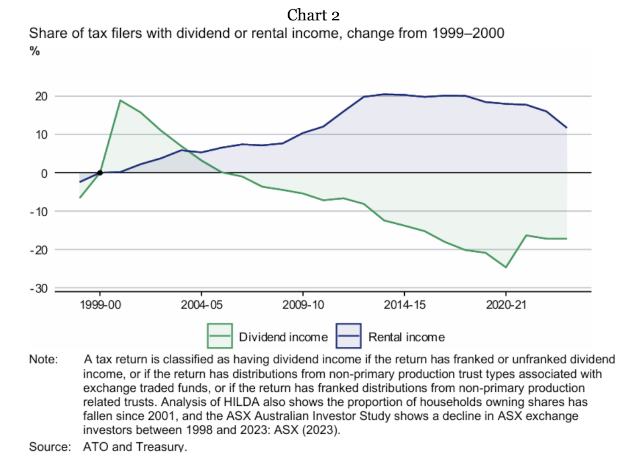
But as Chart 2 below shows, there has been a big reduction in investment income from productive businesses in favour of rental income from housing. That has not helped Australia’s productivity growth and is probably a factor in the low rate of productivity growth over that 20-year period.
Taylor’s other major tax policy initiative was to restore indexation of the bottom two income tax thresholds from 2028-29, and from 2031-32, the top two tax thresholds would be indexed as well.
However, while many commentators will approve removing politicians’ discretion as to when and how income tax rates should be lowered, it is not obvious that a return to indexation will represent a major change in average tax rates. Indeed, Treasury analysis shows that under Labor’s policies, the average tax rate for a worker on average earnings will remain at around 21 per cent or slightly less between 2024-25 and 2029-30 – that is an outcome no different from what Taylor is proposing.
Finally, there is a question about how Taylor will pay for his tax policies. According to the Budget forecasts, these three tax changes will hit government revenue by $6.75 billion in 2029-30. So other things being equal, that is the amount of savings or extra revenue that the Coalition would have to find in its second budget if it wins the next election.
In addition, the Coalition will need to find more money for defence than Labor is promising and to reduce the budget deficit faster than Labor is promising.
Taylor would like us to believe that savings are readily available because of Labor’s “wasteful expenditure”. But according to the Treasurer “Real spending growth averages just 1.5 per cent for the eight years to June 2030”. That is not much faster than population growth and does not suggest that there are lots of opportunities for savings unless services are cut.
Migration
According to Taylor, “With Labor having opened the migration floodgates, the dream of home ownership has become a nightmare”. In other words, Taylor wants us to believe that immigration is responsible for the housing crisis and the rapid increase in dwelling prices relative to incomes. This is the logic underpinning his promise to limit migration to the number of houses built.
But it is generally accepted that the relatively rapid increase in dwelling prices has been caused by supply limitations. We need to increase the density of Australian cities so we can increase the number of dwellings where people want to live. But limiting migration does not fix that problem. Nevertheless, Taylor wants the NIMBYs to determine our migration target.
The Albanese government is instead providing financial incentives to the states to achieve the necessary changes to urban planning laws to facilitate that necessary increase in population density, but it takes time.
A further problem with Taylor’s migration policy is that he has provided no information about how he would implement it. What would be the reduction in the numbers of different categories admitted?
At present skilled migration makes up more than 70 per cent of the permanent migrant intake, and Labor is taking steps to increase that share further and to improve our use of skilled migrants. So depending on which categories of migrants are reduced in number, that could have significant implications for the economy.
And even reducing the number of temporary migrants can create problems. For example, farmers are already expressing their concerns about a reduction in temporary migrants on whom they rely quite heavily. While universities were encouraged by previous Coalition governments to increase the number of foreign students to help cross-subsidise their Australian students, after those governments cut university funding.
Dig and drill, and oppose net zero
But perhaps Taylor’s greatest fantasy is that Australia will be better off by abolishing the commitment to achieve net zero and instead digging and drilling to get more Australian energy resources out of the ground.
This fantasy flies in the face of all the evidence that renewable energy is much, much cheaper. Instead, according to the regulatory authorities, on average last year, 2025, the wholesale price for renewables was $59/MWh compared to $115/MWh for power from coal and gas.
No wonder that Australia’s coal-fired power stations are only operating at 65 per cent of their full capacity, are frequently breaking down, and two-thirds of those remaining are planning to close by 2035.
If Taylor doesn’t know such basic facts as these and understand them, how can he be trusted to run the country?

Michael Keating is a former Secretary of the Departments of Prime Minister and Cabinet, Finance and Employment, and Industrial Relations. He is presently a visiting fellow at the Australian National University.