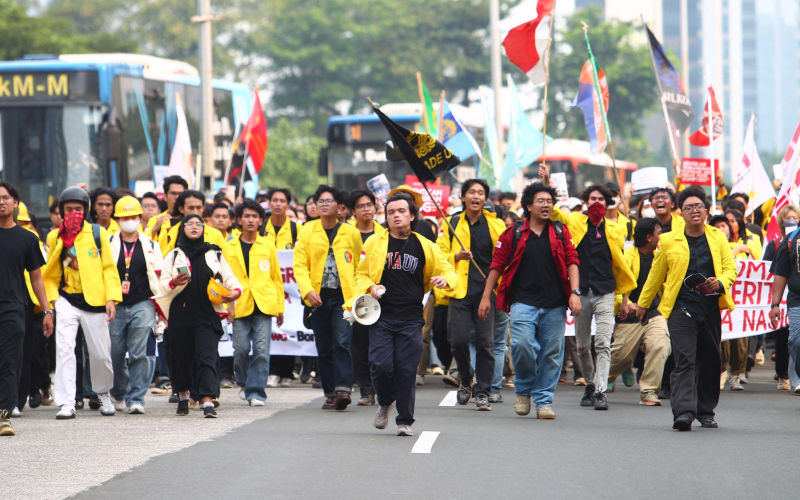
Student protests against Prabowo Subianto’s militarised style of government have exposed anger over prices, corruption and civil liberties, but without broader public support or elite pressure they are unlikely to threaten his hold on power.
In Indonesia, it was flagged as the Big One – maybe a prelude to the fall of the arrogant and feared eighth president, Prabowo Subianto busy turning his nation into a barracks. Even parts of the Australian media got excited, though the story wasn’t about a Sydney druggie in Bali.
But last Friday’s rumpus was never going to be a repeat of the 1998 demos that brought down Indonesia’s second president.
Soeharto had been running the world’s fourth most populous nation for 32 years until the currency crashed. Then the discreet oligarchs who run Indonesia slipped him a note. It read: “Go”.
In last century’s Asian economic crisis, Krismon – krisis moneter – the rupiah crumpled from a steady 2,500 to almost 17,000 against the greenback.
There are still cities in the Republic where the see-through rusting skeletons of half-finished office towers scar the streetscape, monuments to a giant failure, a financial system so badly run that clefts in jungle ironbarks would have been safer repositories.
The losses were staggering; 45 private banks collapsed or were liquidated. More than 70 per cent of the Jakarta Stock Exchange-listed companies became insolvent or went bankrupt.
Armageddon didn’t have to be imagined – it was here.
I wrote later in The Jakarta Post: “Indonesia didn’t break down like Egypt or crash like Syria. The gears grated, the engine coughed, but democracy kept edging forward and stayed on the road, a modern miracle of social change insufficiently acknowledged.”
That’s not happening now.
The demos in Jakarta and other big cities this month were never going to have the intensity of Tragedi 1998. Disgust with Soeharto’s mismanagement and corruption had been brewing for years and only needed the right yeast and conditions to ferment.
It also required the guidance of a respected leader. The man of the moment was a US-educated academic, Dr Amien Rais. Another tick – his involvement with the Muslim movement Muhammadiyah.
In the West, the Father of Reform is Martin Luther, the 16th-century theologian who took on the Catholic establishment. In Indonesia, it’s Professor Rais, now 82.
The other ingredient was provocation. This was provided by the army shooting four unarmed undergrads sheltering at the top private Trisakti University, favoured by many elite families.
Although this month’s student demo was reportedly the biggest since last August’s clashes between protesters and security forces left at least 13 dead.
Affan Kurniawan, 21, was a motorbike courier run over by a military vehicle; he became a martyr and a focus for the protests.
At the demo this month, there were no burnings, only two arrests (not students), no deaths, no leader and no plan other than demands that will head straight to landfill. On the winner’s podium, one short, shouty man of 74 is trying to show he’s not past his use-by date.
Undeterred, the protestors threaten to return next Saturday. If they do, they’ll need new tactics to make an impression. This is not a plea for punch-ups.
As the Father of Civil Resistance Mahatma Gandhi said: “What is gained by violence must be lost before superior violence.”
Last week’s street show reportedly featured about 1,500 Jakarta students in yellow jackets chanting Heading to Bankrupt Indonesia, and getting selfies alongside barricades and cops with shields: “Look, Ibu, I was here.”
Police and military outnumbered the students four-to-one.
Where were the wong cilik, the wee people in a city of 42 million? Where were the TV cameras apart from Kompas?
Are students now so elite they’ve forgotten their roots? The 1789 French Revolution succeeded because it included the sans-culottes.
A theory from Indonesian commentator Jihad Azhar on his blog The Messy Middle:
“Sometimes I think this country survives because its people are too forgiving, too used to suffering, too used to making jokes out of wounds, too used to lowering expectations until neglect starts to feel normal.
“We are so good at enduring that maybe those in power have mistaken our endurance for permission.”
Fortunately, the protestors had the protection of crowds if they chose to mock Prabowo, a dangerous practice for lone critics near CCTV cameras or satpam (security).
Australian political leaders are considered fair targets for public comment. Provided abusers don’t threaten violence or vomit hate, few will care. Not in Indonesia, where a speech deemed insulting to Prabowo, and the “honour and dignity” of his office can cop four years jail.
The bill creating this offence came directly from Prabowo this January, 15 months after the former career general took office and decided his nobility was at risk. (In 1998, he was cashiered for disobeying orders and fled to exile in Jordan. This history is rarely revived.)
It seemed last Friday’s novices’ only plan was to wave banners and demand lower prices for basic goods and fuel. Although bowser premium prices have just risen 30 per cent, the government’s claim that the US-Iran war is impacting imports and limiting opportunities to play with retail prices seems reasonable.
Next demand: end “wasteful state spending” by closing the Free Nutritious Meals (Makam Bergizi Gratis) program. Though driven by public health needs, it has been spoiled by corruption, mismanagement and overspending of the US $28 billion (five-year) budget.
MBG won’t be closed because it’s Prabowo’s pet. He’s sacked some senior staff and promised reform.
Next gripe: The national government is building 80,000 Kop Des Merah Putih (Red and White Village Cooperatives). The colours are on the flag.
The co-ops will compete with privately owned convenience stores and are said to be having problems with staffing and management. This is another Prabowo ideology.
One minister explained the co-ops would “serve the interests of village communities … break the poverty chain in villages and boost villagers’ income.”
Although locals are supposed to be involved, the military is reportedly taking a big role through drafting, getting bank loans and “daily supervision.”
This fits with Prabowo’s intent to militarise civil society by putting serving and retired officers into managing sections of the economy, though many are ill-suited. Another policy that has to go, said the students.
No change coming. Why should there be? The polls seem to show the President has 80 per cent support, so who cares what the activists chant and the elite dislike? Although Prabowo claims he consults widely, the reality is that only he decides policies, and that seems okay with voters.
A Tempo magazine editorial commented: “This effort to govern through threats and spreading of fear moves the country closer to the practices of a military machine. The characteristics of such a model rely on top-down, command-style political decision making …
“The government creates order and stability through coercion, displaying low transparency and restricting civil liberties.”
A few thousand students taking street selfies to show protests can be fun, but it isn’t going to shift Prabowo or electors who like tough guys.
Change awaits a note to the Palace from the oligarchs who run Indonesia.

Duncan Graham has been a journalist for more than 40 years in print, radio and TV. He is the author of People Next Door (UWA Press). He is now writing for the English language media in Indonesia from within Indonesia.
Duncan Graham has an MPhil degree, a Walkley Award, two Human Rights Commission awards and other prizes for his radio, TV and print journalism in Australia. He lives in East Java.