Most governments remain hooked on oil instead of making the vital changes humans and the planet need for global energy transformation.
The self-destructive urge of humans to bring down our civilisation and destroy our children’s future grows stronger by the minute. Never has our addiction to oil looked more like the agonal ravings of a demented junkie.
With a perfectly straight face, world ‘leaders’ talk about freeing up world trade in oil for the sake of the economy, when that is the primary pathway to human destruction. Almost none of them has mentioned the obvious solution: quit oil altogether and substitute renewable energy, as fast as possible. Their focus is on how to delay the inevitable.
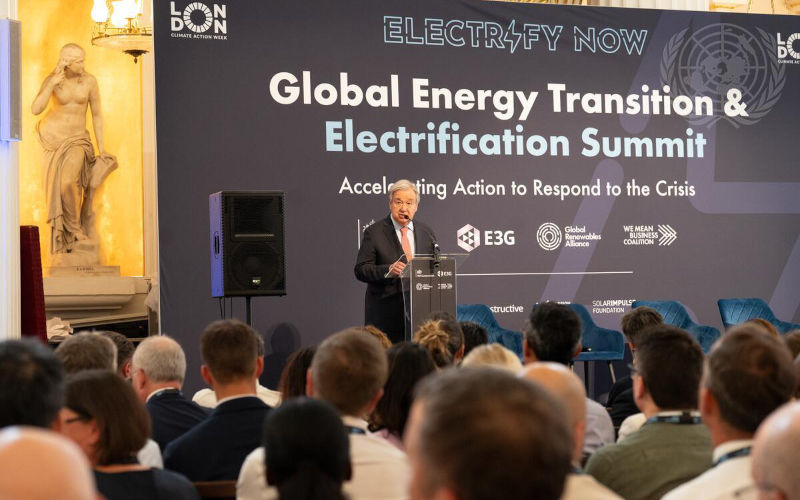
In his address to the London Climate Action Week, UN chief Antonio Guterres stated the world is now in a double crisis of our own making:
Our world is facing first, a climate crisis pushing us toward higher temperatures and closer to catastrophic tipping points and second, an energy crisis exposing the folly of a world hooked on hydrocarbons.
Without oil, the future of civilisation would not be at risk. Without oil, there would be no world economic depression menacing us.
In a rational world, the crisis in the Arabian Gulf would have sent an unambiguous message to every nation: ‘Get off oil, before it bankrupts you’.
In a rational world, the blazing temperatures across the northern hemisphere would have sent an explicit message: ‘Save your children, before it’s too late’.
Alas, ours is not a rational world. Our governments consist mostly of ill-informed politicians lining their own pockets by being the handmaids of Big Oil, humanity’s most lethal drug of choice. They are not serving the interests of their countries, but those of a handful of very rich, mostly foreign shareholders. It is a perfect human suicide pact.
‘Around the world, climate disasters are becoming more frequent, more destructive, and more costly,’ Guterres states, ‘and the World Meteorological Organization has warned we ain’t seen nothing yet’.
He is correct: bearing down is what scientists say could be the worst El Niño event in modern history, bringing with it widespread droughts, famines, fires, water scarcity, overheating, energy failures, disease, war and soaring food prices – on top of those already boosted by the Gulf oil shock. Current predictions show a ‘super El Niño’ – a climate force multiplier – building up across the Pacific Ocean. The last time this occurred on such a scale was 1877 – when there were 1.4 billion humans alive, compared with 8.3 billion today.
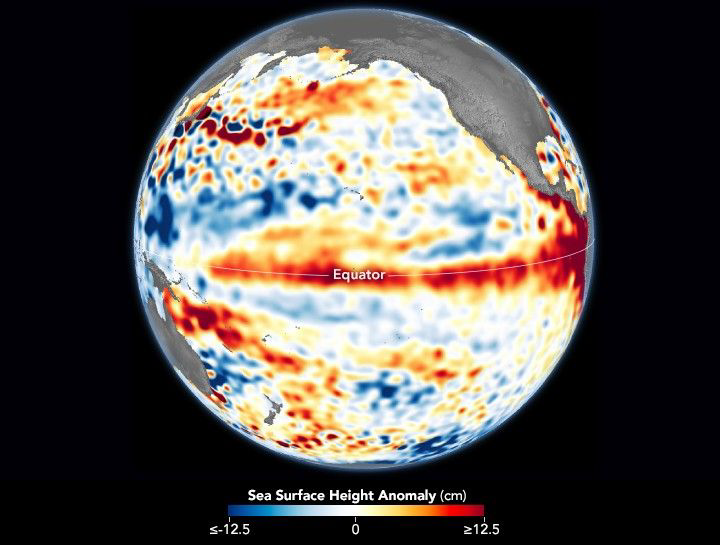
Figure 1. Satellite imagery reveals a rise in ocean height that signals a ‘super El Niño’. Source: NOAA 2026
At the same time, the UN’s Scientific Advisory Board has released an alarming new brief warning of other massive, potentially catastrophic and irreversible changes to the Earth system ahead. These include:
- accelerating loss of polar ice, pushing oceans up by metres over decades to come and displacing millions of refugees
- global loss of coral reefs and the communities that depend on them
- conversion of Amazonian rainforest to dryland savannah
- collapse of deepwater ocean currents, with vast impacts on climate, weather and global temperatures.
Such events exceed the impact of global warming alone:
Tipping of any major Earth system would have catastrophic impacts on humans and the planet. The interaction of these systems can lead to destabilising cascades, spreading irreversible change from one Earth sub-system to many.
Guterres unveiled a 7-point plan aimed at saving the world from disaster by hastening the transition to renewable energy. The main obstacle, however, is that the heavy lifting must be done by nations – and very few nations are willing to escape the oil-greed trap.
A new study shows that allowing the world to continue releasing carbon at present rates will slash incomes in Europe (for instance) by 27 per cent by 2100 – but this could be kept to -7 per cent if the world moves swiftly to peg global heating at +1.5 degrees through a renewable energy transformation.
Guterres did offer a shred of hope:
Renewables are the cheapest, fastest and most scalable source of new electricity in most of the world. Since 2010, the cost of solar has plummeted by almost 90 per cent, onshore wind by more than 70 per cent, and battery storage by 95 per cent.
This at a time when fossil fuel prices are in danger of doubling, thanks to Trump’s war.
If this remains the case, Trump may have unintentionally succeeded where all others have so far failed – by creating the essential conditions for the greatest energy transition in human history: the ‘mother of all oil shocks’ set off by his needless Gulf war, combined with searing Earth temperatures. This is ironically the opposite of his proclaimed intentions to boost fossil fuels and sabotage climate action – and, as a result, will strand the USA like a beached whale with yesterday’s energy technology in a time of universal advancement and rising heat.
Meanwhile the Chinese tortoise is quietly lapping the US hare by trailblazing the renewable energy era, making itself the world’s go-to market for solar, wind, batteries, EVs, AI, robotics, defence equipment, heavy transport, industrial, medical and home appliances. It is installing over 430 gigawatts of renewable power a year. It is adapting its grid to renewables, adding safer nuclear thorium reactors, aims to start cutting its carbon emissions by 2030 and become carbon neutral by 2060. It is stealing the breath from US ‘tech bro’ lungs by giving its AI away for free.
From a climate perspective, China is leading the world both in the adoption of renewables (2.34TW installed by 2027) and in devising better ways to adapt to the inevitable climate crisis. In placing far more emphasis on building a sustainable society than on one where greed and war are the chief attributes, it is displaying a new model for leadership to the world. That said, it has yet to get its head around the tenfold human emergency set out as megarisks by the Council for the Human Future.
Every rational argument now points to the urgent necessity for global energy transformation, and China is showing the way. However, most governments, corrupted by the bribery and misinformation of Big Oil, refuse to make the vital changes, preferring to sacrifice their grandchildren to personal greed today.
Such a species, Charles Darwin might observe, is unfit to survive.

Julian Cribb AM is an Australian science writer and author of six books on the human existential emergency. His latest book is “How to Fix a Broken Planet” (Cambridge University Press, 2023)