US regional strategy questions, donations-theft investigation, massive expansion of chip plants, Pakistan military’s changed political fortunes, China’s new education blueprint, and the world’s rarest apes’ extinction threat.
Japan’s Sanae Takaichi and India’s Narendra Modi met in New Delhi on Thursday 2 July at a time of concern about China’s economic sanctions against Japan and its increasing regional influence.
The two prime ministers agreed to work together on AI, economic security, clean energy and defence, The Japan Times said. Defence co-operation between the Quad partners would include joint training in the Indian Ocean, naval vessel maintenance, and co-development of military hardware, to be manufactured in India.
Takaichi was on a three-day trip to India, a trip which coincided with debate in Asian media about the significance of the US military’s decision to scrap the phrase “Indo-Pacific” – a debate tinged with consternation.
The Pentagon said last month that the Indo-Pacific Command would revert to its historic name of Pacific Command, or PACOM. “Indo-Pacific” was only adopted by the first Trump administration in 2018. The Pentagon said there would be no change in the command’s mission or area of responsibility.
A Japan Times editorial said, however, the change might have been symbolic but the symbolism was substantive “Names reveal strategic priorities,” the paper said.
The Indo-Pacific strategic framing had first been suggested by the late Shinzo Abe, in 2007, and its adoption by the US suggested a convergence of views, the paper said. But it seemed a reassessment was now underway.
A commentary in Hong Kong’s South China Morning Post said the change raised questions about Washington’s continuing commitment to India. It quoted American political scientist Christopher Clary as saying the decision was senseless. “It is reasonable for sceptics to wonder whether the goal is to appease China,” Clary said.
The decision to adopt “Indo-Pacific” reflected a strategic vision that placed India at the centre of Washington’s approach to Asia, said an analysis in the Asia Times news site. The article, by geopolitical analyst Saima Afzal, asked if Washington had started to reassess assumptions that shaped the strategy.
“[P]olicymakers under Trump increasingly seek partners capable of reducing America’s strategic burdens,” she wrote. “As strategic competition with China intensifies, the US has strong incentives to avoid becoming repeatedly drawn into regional crises that divert attention from its broader priorities.”
Indian foreign policy expert C Raja Mohan said Takaichi’s visit to India this week highlighted an important fact: Indo-Pacific as a geopolitical construct would live on. Writing in The Indian Express, Mohan, a contributing editor, said the logic of the Indo-Pacific would continue to drive regional actors like India and Japan. Modi’s imminent trip to Indonesia, Australia and New Zealand would reinforce the proposition.
“As China expands simultaneously into the Pacific and the Indian Ocean, and as Japan emerges as an increasingly capable strategic actor, the integration of the two oceans will only deepen,” he said. “The Indo-Pacific ultimately rests not on American terminology but on Asian geography and Asian power politics.”
Police find lapses in temple’s money-counting routines
A scandal centred on the apparent theft of donations has engulfed a sacred symbol of Narendra Modi’s Bharatiya Janata Party – a temple dedicated to the Hindu god Ram, built on the site of a 16th century mosque after long political, legal and community battles.
In 1992, a mob tore the mosque down, sparking religious riots that killed almost 2,000 people, mostly Muslims. In 2019, India’s Supreme Court allowed the building of the Ram Mandir, a vast temple.
Modi presided over the temple’s consecration ceremony in January 2024 and the temple became a pillar of the BJP’s Hindu-majority identity.
But last month the temple was hit by an investigation into the alleged embezzlement of donations of money and valuables. According to The Indian Express, the temple trust had received the equivalent of more than A$530 million in cash alone.
“Allegations of financial irregularities – theft and embezzlement of funds and valuables donated to the temple – therefore constitute not just a grave breach of public trust but also point to a serious institutional failure,” the paper said.
Modi’s promise of zero tolerance of corruption was now under scrutiny. “The investigation must follow the evidence wherever it leads,” the paper said.
By late last month, a police special investigation team had found lapses in the shrine’s donation management system, The Hindu reported.
Standard operating procedures, such as deploying security guards during counting, frisking people entering and leaving the counting room and preserving CCTV footage of the counting for 180 days, had been violated, the paper said.
Eight people associated with the counting processes had been arrested.
The Statesman said the police team had been given a 15-day extension to complete its investigation. In an opinion piece published on 30 June, the paper said the controversy had become a test of whether India’s public institutions could uphold accountability when faith, politics and national symbolism intersected.
“For an institution sustained by the devotion of millions, transparency is not merely an administrative obligation,” it said. “It is a moral one.”
Why Korean company chief wants good schools
South Korea is placing an $820 billion bet on the future of the AI boom. The country is the world’s biggest memory-chip producer, with more than 60 per cent of the global market, and AI creates massive demand for memory chips.
Samsung Electronics and SK hynix this week announced plans to invest 881 trillion won (about A$823 billion) building four new fabs (semi-conductor fabrication plants) and advanced packaging facilities in provinces distant from Seoul.
The semi-conductor initiative was aimed at doubling Korea’s DRAM (dynamic random access memory) production capacity within five years, The Korea Herald said and reported that President Lee Jae Myung described the chairs of Samsung and SK Group as national heroes.
The Korea Times said in an editorial the plan to establish a semiconductor cluster in the southwest was one of the most significant industrial policy initiatives in the country’s history.
But success would depend on the government’s ability to turn promises into results. Experience with an earlier technology cluster should serve as a cautionary lesson, it said. Land acquisition, environmental approvals, water infrastructure and power supply had all caused delays.
“These bottlenecks reveal a persistent weakness in public administration,” the editorial said. “Major investment projects often move more slowly than the private capital ready to finance them.”
The Korea Times said in a news story that other projects, including AI data centres, would take the total megaproject public and private investment to 1,350 trillion won (about A$1,260 billion). Labour and industrial infrastructure were the biggest challenges. Experts had raised concerns about relocating experienced engineers from the capital to regional hubs.
Lee had pledged comprehensive government support for the chipmaking project, Nikkei Asia said. He would review regulations and options for tax and fiscal support, while using the region’s abundant wind and solar power to supply the vast amounts of power the chip cluster would need.
The Korea Herald reported SK hynix chief executive Kwak Noh-jung had employment issues on his mind – especially the need to avoid creating “weekend couples” (families split by distant job postings) – when he made his first request to the government.
He asked for good schools.
Military chief dominant at home, hobnobbing abroad
Anti-army sentiment in Pakistan exploded with the removal of Imran Khan as prime minister in 2022 and attracted global attention amid election rigging in 2024. But it is now fading, says an analysis in The Diplomat.
“The military has witnessed a stark turnaround over the past 12 months,” the article says.
The vicious crackdown on Khan, his wife and his party continues. Khan has been in prison for almost three years and his health is deteriorating. His wife, Bushra Bibi, is also in prison and at different times members of Khan’s Pakistan Tehreek-e-Insaf Party (PTI) have been arrested and jailed.
The military’s fortunes began picking up after the ceasefire in last year’s India-Pakistan clashes, the story says. It allowed Islamabad to claim victory, especially when it was confirmed that Pakistan had downed a number of Indian jets.
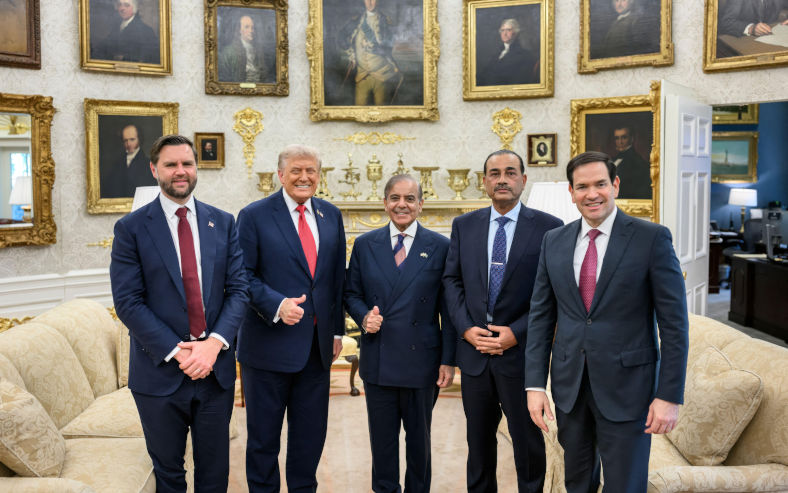
Since then, Pakistan has continued to woo Donald Trump and has become the main broker in the US-Iran negotiations. Trump has repeatedly called army chief Asim Munir “my favourite field marshal” and Vice-President J D Vance has said Munir is “one of two most important people” in his life. Munir is the most powerful man in Pakistan and one of the most influential figures in the region.
The turnaround has caused a re-think within the PTI, says the article, written by writer and editor Kunwar Khuldune Shahid. Party leaders are now open to overtures from the government, led by the Pakistan Muslim League-Nawaz (PML-N) to embrace a charter of democracy. This was originally meant to boost parliamentary supremacy but is now largely seen as an army leadership ploy to maintain its authority.
“Many in the PTI ranks believe that a compromise with the military is the only way forward to maintain any political relevance,” Shahid says. He quotes a PTI leader as saying the military establishment has become so powerful it is impossible to uphold democracy in Pakistan.
The idea of a charter of democracy has been discussed for some months. The Express Tribune reported in December that PML-N leaders agreed a charter was necessary to dilute political animosity in the country. A story in Dawn in February said the government had invited the opposition to sit together and hold talks on the charter. Khyber News said last month Prime Minister Shehbaz Sharif had called on the opposition to work together for national unity and long-term political stability.
Shahid’s story in The Diplomat says many in the PTI believe Khan would not endorse the charter, as compromise with his enemies would undo his legacy.
But, he says, Khan and the PTI might find it hard to undo the autocratic policies of a military leadership that is basking in totalitarian acts at home and hobnobbing with global powerbrokers.
Beijing’s education plan for global technology competition
China publicly seems not to place much faith in university ratings. The latest QS World University Rankings, published last month, were not reported, at least not in the official English-language media.
Yet five Chinese universities were placed in the top 50 globally with two, Tsinghua and Peking universities, in the top 20 – a reflection of the importance Chinese society has assigned to education, historically and now.
China’s State Council, the national cabinet, this week released a blueprint for education for the next five years; it should not be viewed as just another bureaucratic document.
South China Morning Post reported that China had placed serving national strategy and achieving self-reliance in technology and talent at the heart of its education agenda.
It said the blueprint had set out 15 programs for building China into an educational powerhouse. These included strengthening vocational education, placing greater emphasis on science and engineering and creating “globally influential” training centres for doctoral students.
Policymakers, it said, were responding to global technological competition and a shrinking school-age population.
“International competition for top talent and the commanding heights of technology has become unprecedentedly fierce,” said a briefing note from the Ministry of Education. The plan sought to look beyond education itself, the briefing said. The main aim was to enhance education’s role in supporting economic and social development amid demographic change and technological disruption.
The paper said authorities would encourage overseas universities specialising in science and engineering to set up co-operative educational programmes in China. Leading companies would be invited to run, or co-run, vocational schools.
The blueprint called for a gradual shift to smaller primary and secondary school classes, while expanding undergraduate intakes at “double first-class” universities by more than 100,000 students.
SCMP said the double first-class program was a performance-based funding system akin to the Public Ivies in the US (state-funded universities that offer Ivy League levels of education.) The program aimed to turn more than 100 universities and their top departments into global academic heavyweights.
Only 800 survive: threat to rarest orangutan species
A mountainous forest region of North Sumatra, known as the Batang Toru ecosystem, is home to the world’s rarest species of great apes, the Tapanuli orangutan. Fewer than 800 survive in the wild; the flooding and landslides caused by Cyclone Senyar last November killed an estimated 58.
A recent Bangkok Post story spelled out their precarious hold on existence, as a single climate-related landslide event brought the Tapanuli orangutan even closer to extinction. Flooding also wiped out sources of food and shelter, it said.
The paper said scientists analysed satellite evidence of landslide scars in the region and found that 8,300 hectares of forest – 11 per cent of the Batang Toru ecosystem – had been destroyed. They then overlaid the lost forest area with Tapanuli orangutan population maps to work out an estimate of the population loss.
Environmentalists had long campaigned against industrial activity in the region, particularly a hydro-electric dam and a gold mine. “To prevent the first modern extinction of a great ape species, Indonesia must permanently protect the Batang Toru ecosystem,” said researcher Jatna Supriatna, University of Indonesia.
But a commentary in The Jakarta Post said a study in the journal Biological Conservation had presented a more complex problem. Deforestation in the region had not been driven solely by big commercial projects. Smallholder agriculture and small-scale logging had accounted for about 70 per cent of the total loss.
The commentary, written by Onrizal, a senior environmental researcher at Sumatera Utara University, Medan, said the landscape was being squeezed by energy and mining infrastructure, road expansion, agriculture, logging, ambiguous land tenure and climate disasters.
The primary concern for Tapanuli orangutan was not simply the total number of hectares cleared but precisely where the loss occurred. Losing a narrow corridor of forest that connected two populations was far more catastrophic than losing a bigger tract on the edge of the forest.
“A credible ESG (environmental, social and governance) framework must move beyond superficial sustainability reports and ceremonial tree-planting,” Onrizal said. “It must identify and mitigate the specific ecological risks that matter most.”

David Armstrong is the Editor-in-Chief of Pearls and Irritations. David is one of Australia’s best respected reporters, editors and media executives, with more than five decades of experience in Australia and Asia. A contributor for more than 10 years, David writes a regular column on Asian media.