The World Cup created a rare global community, then FIFA and Trump tried to turn it into advertising inventory, spectacle and political theatre.
At the beginning of the World Cup, I wrote optimistically about what football could still offer us. Watching Australians from vastly different backgrounds celebrate the Socceroos, I saw something larger than sporting success. I argued then that beneath the broadcasting rights, sponsorships and commercialisation remained something stubbornly human: people searching not simply for entertainment, but for connection.
The tournament largely vindicated that hope. Across six weeks, supporters carried their histories, songs, colours and identities into a shared space. Nations divided by language, religion, politics and conflict met under common rules. Smaller footballing countries were not merely permitted to attend; they were seen, heard and taken seriously. Once again, the World Cup created the experience its name promises: not simply an international competition, but a temporary gathering of the world.
That is why what followed felt like more than the familiar excesses of modern professional sport. FIFA had assembled an extraordinary global community. Yet as the tournament progressed, and particularly as the final approached, it became increasingly difficult to escape the sense that this community was being treated as a commercial asset. The audience had not merely gathered to watch football. It had been gathered, segmented and sold.
The World Cup brought the world together. FIFA then sold access to the crowd.
Staging the tournament across Canada, Mexico and the United States was presented as continental cooperation, and in one sense it was: three countries and 16 host cities allowed a vast range of communities to participate in an event ordinarily concentrated in one nation. But the scale carried consequences. Teams moved between different climates, altitudes and playing environments, some competing in climate-controlled stadiums, others outdoors in oppressive heat and humidity.
Weather has always been part of football but here the variation was not incidental; it was built into the design. Nearly one in five matches was reportedly played in conditions reaching levels at which the international players’ union recommends play be delayed or postponed. FIFA’s response was mandatory three-minute hydration breaks midway through each half of every match, even in cooler, climate-controlled stadiums. A measure justified by the most difficult venues became a permanent alteration to every game. In a competition decided by the finest margins, some players were asked to manage conditions that others scarcely encountered.
Environmental inequality was one concern; political inequality a more troubling one. A host is not required to suspend its laws, but FIFA does have a responsibility to choose hosts capable of welcoming the people involved in a genuinely international competition. That principle was repeatedly tested by US immigration policy.
Iran’s players eventually received permission to enter the country but some support staff did not, so the team shifted its training base from Arizona to Tijuana, across the border in Mexico. Whatever one thinks of the Iranian government, its footballers had qualified for the same tournament as every other team and should have been able to prepare under comparable conditions.
More disturbing was the treatment of Somali referee Omar Abdulkadir Artan, selected by FIFA and expected to become the first Somali to officiate at a World Cup. Despite holding a valid visa, he was refused entry over ‘vetting concerns’. FIFA paid his tournament fee but compensation could not replace the opportunity taken from him.
The boundary between domestic politics and football blurred further when Donald Trump personally contacted FIFA President Gianni Infantino to seek a review of a red card issued to US striker Folarin Balogun. FIFA subsequently lifted the suspension. There may have been a footballing case for a review but that is not the point. Disciplinary decisions must be made, and be seen to be made, independently. Once a host nation’s president can lobby FIFA on behalf of his country’s leading player, confidence in the equality of the rules is weakened. Human-rights organisation FairSquare had already complained to FIFA’s Ethics Committee that Infantino’s relationship with Trump breached FIFA’s requirement of political neutrality. After receiving little more than an acknowledgement, it escalated the complaint to the International Olympic Committee’s Ethics Commission.
The World Cup asks every player and supporter to believe in a common field governed by common rules. FIFA’s closeness to political power made that belief increasingly difficult to sustain.
All modern international sport is commercial. The World Cup has not been commercially innocent for a long time. But this tournament crossed another boundary: commercialism no longer merely surrounded the football; it began to reorganise it. FIFA insisted the hydration breaks were motivated solely by player welfare, yet across 104 matches they created more than 10 additional hours of predictable live broadcast time. A pause introduced to protect players had also become advertising inventory.
The final brought this changing philosophy into full view. The pre-match production borrowed the language and theatre of American combat sports, including ‘Let’s get ready to rumble’. Football’s traditional 15-minute halftime interval was extended to accommodate the first entertainment show staged during a World Cup final. What had always been a brief period for players to recover and prepare became another globally marketed spectacle. The objection is not that American culture was visible; every host nation should bring something of itself to a World Cup. It is a question of proportion and ownership. A host should welcome the world, not remake the world’s game in its own image.
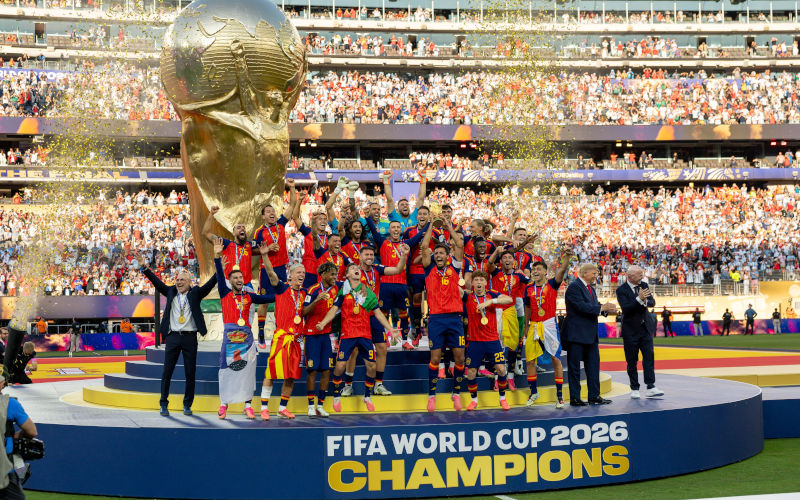
Then came the final presentation. As Donald Trump and Gianni Infantino entered the field, they were met by loud booing. Trump remained on the podium among the victorious Spanish players until he was guided aside as the captain prepared to lift the trophy. It was a small scene, but it seemed to embody the entire tournament. Political power had not been satisfied with hosting the occasion; it wanted to occupy its defining image.
The booing did matter. It reminded us that a crowd is not simply a market. It is a collection of people capable of judgement, resistance and a sense of what properly belongs to them.
The world came together. FIFA sold access to the crowd, converted pauses into commercial property and allowed political power to intrude upon the game. Yet, in the final moments, the crowd found its voice. Perhaps the stubbornly human survived after all.

John Frew worked in public education, including as foundation principal at a secondary school for students with Conduct Disorder and Oppositional Disturbance. John has authored numerous books the latest being ‘Neuroscience and Teaching Very Difficult Kids’. Since retiring, he has continued to comment on social issues.