China’s manufacturing advantage cannot be explained by subsidies alone. Tariffs may offer temporary protection, but rebuilding Western industry requires investment in skills, capacity and competitiveness rather than simply blocking imports.
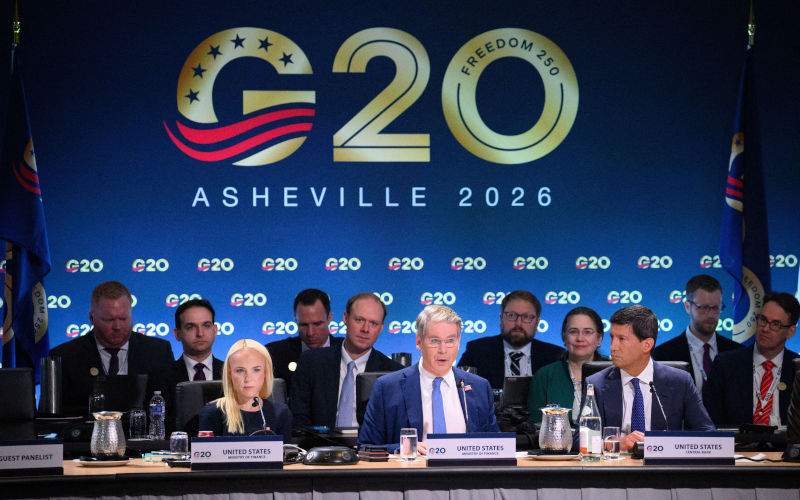
The G20 finance ministers left Asheville, North Carolina, on September 1 with no joint communiqué. Nineteen of twenty backed language against non-market policies that breed over-reliance on exports. China dissented.
The meeting closed with a statement from the chair instead. US Treasury Secretary Scott Bessent called the problem a “never-ending stream of cheap exports.”
Washington and Brussels will read 19-to-1 as vindication. But a headcount is not a diagnosis. Nineteen economies can agree on the symptom and still misdiagnose the disease.
The dominant Western story is that China’s manufacturing position rests on subsidies and dumping.
That story is not false. It is incomplete.
And the gap between the two is expensive, because an incomplete diagnosis produces remedies that do not work.
Start with what nobody disputes. China’s goods exports hit $3.77 trillion in 2025, up 6.1 percent, while imports stayed flat at $2.58 trillion. The goods surplus reached a record $1.19 trillion. When China joined the WTO in 2001, exports totaled about $266 billion—a fourteenfold growth in twenty-four years.
A surplus that large, next to stagnant imports, deserves multilateral attention. Beijing’s own leadership has warned about ruinous price wars at home. The imbalance is real. The explanation is the problem.
The subsidy story is true. It is also insufficient.
China subsidises. Provincial governments hand out cheap land, patient credit from state banks, and tax relief to priority sectors: solar, batteries, steel, electric vehicles. WTO rules bar subsidies tied to export performance. Beijing frames its support as a matter of domestic industrial and environmental policy. Much of it is indirect enough to make a clean legal case hard. Western trade lawyers are not imagining this.
But subsidies are a necessary condition, not a sufficient one.
Cheap money pulled more than 300 firms into China’s EV sector. It did not decide which ones lived. What followed was a price war brutal enough to kill most of them. Survivors had to scale immediately, run on thin margins, and iterate faster than their capital burned. Subsidies created the contest. Competition picked the winners.
Washington knows this mechanism. Operation Warp Speed used federal funds to compel parallel private development of COVID-19 vaccines. The CHIPS Act and the Inflation Reduction Act pushed public capital into strategic industries at a scale Beijing would recognise.
The difference is design, not principle.
What money cannot buy
Ask analysts instead of politicians and the picture changes.
BYD does not just assemble cars. Through its FinDreams unit, it refines battery chemicals and builds its own LFP Blade batteries. A semiconductor arm, founded in 2004, designs chips for its power electronics. Reported battery self-sufficiency runs near 95 percent. That is not a subsidy.
That is twenty years of vertical integration compounding into cost, speed, and supply control. In 2025, BYD sold roughly 4.6 million new-energy vehicles, more than a million of them outside China.
Automation says the same thing. China accounted for 54 percent of global industrial robot installations in 2024, with an operational stock exceeding 2 million units. Forty-five percent of the world’s automotive-sector robot installations occurred there. Add to that the millions of engineering graduates China produces each year. The cost advantage no longer looks like a trick. It starts looking like accumulated capability.
Tariffs undermine capability building
Here is what G20 finance ministers missed in Asheville.
The European Union imposed countervailing duties of up to 45.3 percent on Chinese EVs. BYD did not retreat. Instead, it accelerated plants in Hungary, Turkey, and Brazil.
Exclusion turned an exporter into a multinational. The host country gained access to the factories, supplier networks, and process knowledge. The excluding country got a price increase.
The 19-to-1 vote at the G20 meeting hides divergent incentives, too. German automakers earn heavily in China. Brazil and much of ASEAN would rather host Chinese capacity than block it. A coalition built on shared grievance but no shared remedy fractures at the first bilateral deal.
Tariffs are also paid at home. Consumers squeezed by the cost of living chase affordable, reliable goods. Nobody is forced to buy an imported EV or e-bike.
The political worry is fair enough.
Will the domestic industry still exist in ten years to employ the people buying those imports?
But protection with no deadline and no capability milestones is not industrial policy. It is deferral. The United States hollowed out its manufacturing base over three decades. It now faces a skilled-labour shortage and permitting friction.
No tariff schedule fixes either.
Things to consider before Miami
The G20 Leaders’ Summit opens in Miami on December 14. Three months is enough to move from grievance to terms.
Three terms are worth negotiating.
First, put a clock on protection. A tariff should have an expiry date, and the industry it shelters should meet stated cost and output targets before that date arrives. Shelter with no deadline never ends. It just gets renewed.
Second, let Chinese firms build plants — but set the terms. How much of the car has to be made locally? Which domestic suppliers get qualified? How many local engineers get trained on the line? A factory you host teaches your workers something. A factory you block teaches them nothing.
Third, China should get its own households spending more. That is not a favour to Washington. A country that depends on foreign buyers is exposed the moment those buyers close the door. They are closing it now.
Blame is cheap. It requires no coordination and no capital.
Competing requires money, workers, permits, and patience.
The hard path buys a decade of discomfort. The easy path buys a decade of comfort. Only one of them leaves an industry standing at the end.

Christopher Tang
Christopher Tang is a distinguished professor at the UCLA Anderson School of Management