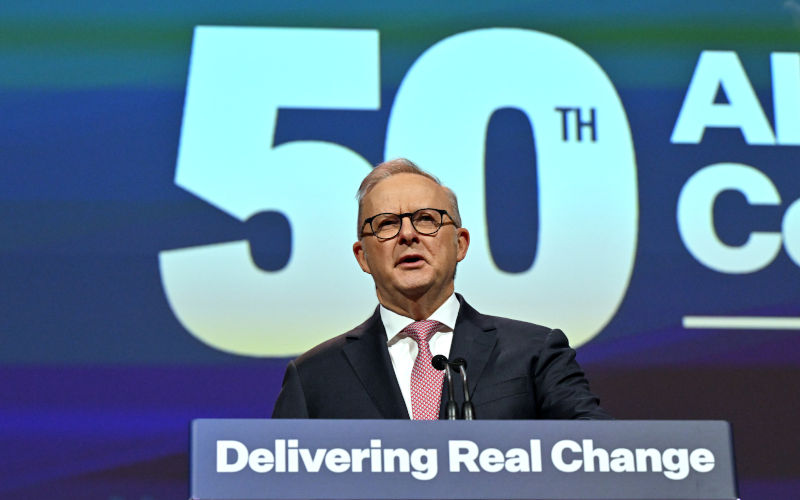
Anthony Albanese acknowledged structural problems in the economy at its National Conference, but Labor still treats capitalism as a system to be repaired rather than transformed.
Anthony Albanese came tantalisingly close to saying something profound at Labor’s 50th National Conference. Australians, he said, have every reason to feel that “the economy is simply not working for them”. This was not merely pessimism or political dissatisfaction. “It’s a reality people are up against.”
Quite so. But if the economy is not working for millions of Australians, the obvious question is: why?
Albanese even acknowledged “structural problems in the economy”. Then, having opened the door to a serious examination of Australian capitalism, he promptly closed it. The answer became the familiar Labor catalogue: cost-of-living relief, tax cuts, higher wages, Medicare, housing assistance, Free TAFE, household batteries and better-funded schools.
All worthwhile. All capable of making lives better. But none amounts to an explanation of why an extraordinarily wealthy country increasingly leaves working people struggling to afford housing, accumulate security, raise families and believe their children will enjoy better lives than they did.
The giveaway comes when Albanese says that “faults in the system can be fixed”. There, in six words, is contemporary Australian social democracy. The system is not fundamentally at fault. It merely contains faults. Labor’s role is therefore not to transform the political economy but to repair it.
Capitalism remains the operating system. Labor supplies the updates.
This represents an extraordinary retreat from Labor’s origin story. Its own constitution still speaks of the “excesses, injustices and inequalities of capitalism”. It still calls Labor a democratic socialist party. It still commits the party to redistributing political and economic power, public enterprise, greater equality of wealth and income and democratic participation in industry.
Where was any of that in Albanese’s speech?
There were workers, certainly. Cleaners, shelf-stackers, nurses, teachers, aged-care workers, police, firefighters and paramedics were invoked as the people Labor was created to serve. Albanese spoke genuinely and powerfully about people who “work their guts out”.
But what does Labor now offer these workers? Higher wages, lower taxes, better services and a chance to buy a house.
Again, all desirable. But notice what has disappeared. The worker is a wage-earner, taxpayer, consumer and prospective property owner. The worker is rarely imagined as an economic citizen entitled to exercise democratic power over the institutions governing working life. Labor wants workers to receive a better share. It no longer seriously asks whether they should have a greater say.
Housing exposes the problem perfectly. Labor now acknowledges that public policy helped turn Australian housing into a speculative asset and privileged investors over aspiring homeowners. But its ambition remains overwhelmingly to help more people enter the property market. Why not challenge the model itself? Why not rebuild public housing on a scale commensurate with the crisis, establish powerful public development agencies, expand cooperative and community housing, use public land strategically and progressively unwind the transformation of shelter into a vehicle for wealth accumulation? Instead, Labor seeks to make entry into the existing system somewhat easier.
Artificial intelligence reveals the same intellectual boundary. Albanese wants mandatory standards, protection for workers and creators and limits on environmental damage. Good. Yet the really important questions remain unanswered. Who will own the models, data and infrastructure? Who will capture the enormous productivity gains? Why should Australians merely regulate technologies owned elsewhere rather than collectively owning some of the technological infrastructure of the future?
The ecological crisis is treated similarly. Renewable energy becomes another opportunity for investment, jobs and growth. But there is little recognition that an economic system organised around perpetual expansion on a finite planet poses a deeper problem. Climate change is something to be managed within the growth model, rather than an invitation to reconsider the model.
Even small business, supposedly another constituency Labor represents, barely appears as an economic class. Yet workers and small businesses increasingly confront the same concentrated powers: banks, insurers, supermarket oligopolies, commercial landlords, digital platforms and multinational corporations. There is the basis here for a powerful twenty-first-century democratic coalition against monopoly and rentier capitalism. Labor barely articulates it.
Then there is sovereignty. Albanese says Labor is “building our sovereignty in defence” through record expenditure and defence manufacturing. Yet the contradiction at the heart of AUKUS goes unexplored. Can Australia really build sovereignty by making itself more dependent on American and British military technology, intellectual property, supply chains and strategic decisions? Saying sovereignty does not make dependency disappear.
The great absence throughout the speech is economic power. There is virtually nothing about wealth concentration, monopoly, financialisation, rent extraction, corporate ownership, land, inheritance, multinational power or who captures the gains from rising productivity.
Most remarkably, there is scarcely any serious discussion of capitalism itself. Old Labor, at its best, asked uncomfortable questions: Who owns? Who controls? Who benefits? Who decides? Contemporary Labor increasingly asks a different question: how can government make the existing economic system deliver somewhat better outcomes? That is the difference between economic democracy and economic management.
Perhaps the most extraordinary phrase in Albanese’s speech is his declaration that Labor chooses “progress over protest”.
What an odd thing for a Labor leader to say.
Labor exists because people protested. Workers organised, withdrew their labour, marched and demanded political representation. The eight-hour day came from protest. Women’s suffrage came through agitation and protest. Opposition to conscription involved protest. Environmental protection repeatedly emerged from protest.
Progress and protest are not opposites. Throughout Labor history, protest has often been the force that made progress possible.
Albanese nevertheless provides the beginnings of a better answer when he calls for “an economy that works for people, not the other way around”. Precisely. But such an economy cannot be created merely by reducing electricity bills, adjusting taxes and helping people borrow enough to buy extraordinarily expensive houses. It requires changing the distribution of economic power.
It means rebuilding public enterprise, confronting monopoly, dramatically expanding public and cooperative housing, strengthening unions while democratising workplaces, taxing economic rents and accumulated wealth, capturing natural-resource rents for the community and using Australia’s enormous superannuation savings to build Australian productive and technological capability.
It requires an ecological economic strategy that asks not merely how Australia can keep growing, but what should grow, what should shrink, what should be publicly owned and what kind of economy can prosper within planetary limits.
Above all, Labor needs to recover imagination and courage. Albanese has recognised the symptom: too many Australians believe the economy no longer works for them. But Labor still refuses to fully diagnose the disease. Until it is prepared to ask again who owns, who controls, who benefits and who decides, “real change” will remain principally the repair of a system Labor once existed to transform.

Stewart Sweeney
Stewart Sweeney is a writer and public policy advocate with a longstanding interest in the evolution and future of capitalism. He migrated from Scotland to Adelaide in 1975 to work with Premier Don Dunstan on industrial democracy. A former academic and trade unionist, he continues to contribute to public debate on economic justice, democratic reform, and sustainable development. His work reflects a deep commitment to the common good and the role of public purpose in shaping Australia’s future.