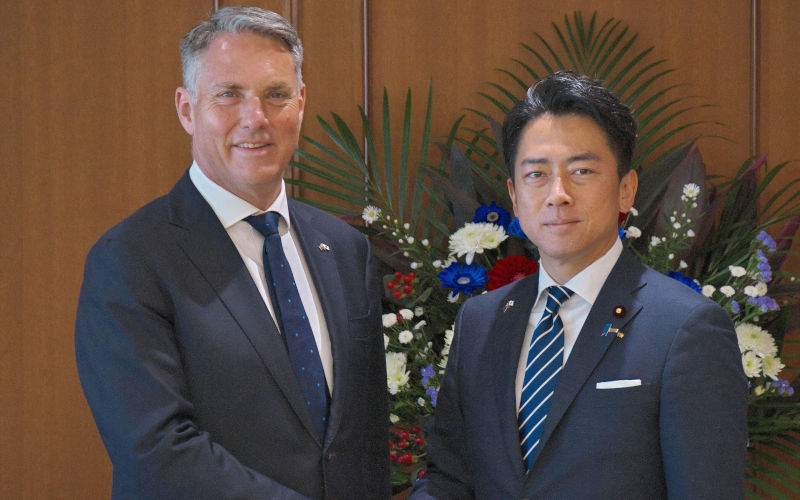
The Australia–Japan relationship is critical to energy, economic and regional security, and must be strengthened to respond to a more fragmented and uncertain global order.
Japanese Prime Minister Sanae Takaichi will visit Australia in early May 2026 – on the eve of the 50th anniversary of the Basic Treaty of Friendship and Cooperation and almost 70 years on from the 1957 Agreement on Commerce that started it all – an important time for the bilateral relationship and regional stability.
Disruptions to oil and fertiliser supplies due to the closure of the Strait of Hormuz are the latest in a long line of shocks to a fracturing global order. For Australia and Japan, it is also a moment of clarification. Australia and Japan’s exposure to turmoil in global energy markets underlines a strategic truth that has too easily been taken for granted – that the two countries are existentially important to each other’s economic security.
Australia supplies just under a third of Japan’s energy needs, over two-thirds of its strategic raw materials and a significant share of its imported foodstuffs. There is no other bilateral relationship in the developed world that combines such deep economic complementarity, an alliance partnership with the United States and a stake in a stable and open rules-based international order.
The starting point is to recognise that the disruption now reshaping the global order is not temporary. The combination of a US–Israel war against Iran, a protectionist and revisionist United States, the steady unwinding of multilateral economic rules and the rise of China cumulatively amounts to a regime change in the conditions on which Australian and Japanese prosperity has rested for three-quarters of a century. Neither country can ride these changes out with reactive policies as price takers in the global order.
A new conception of comprehensive security is urgently needed. The temptation in both Canberra and Tokyo will be to define security narrowly – in terms of their alliance with the United States, defence interoperability and military contingency planning.
Those things matter, particularly as the international security environment has changed significantly. Australia’s commitment to acquire and build the upgraded version of Mogami-class frigates with Japanese partners is a substantial signal of trust between governments and industries that not long ago would have been impossible to imagine.
But headlines about frigates cannot obscure other important tasks. Comprehensive security in 2026 is about energy, food, fertiliser, critical minerals and the security of the modern technological infrastructure that supports them. It is a new form of Japan’s idea of comprehensive security from the 1970s. Economic security is central to comprehensive security, and neither can be achieved without openness, now at risk from correlated global shocks. Together, the two countries can lead the strengthening the rules and norms of the open trading system as the ultimate protection against weaponisation of trade and further shocks, not limit themselves to defensive and reactive economic security policies.
The Australia–Japan bilateral framework is still underdeveloped relative to the stakes in its management. The many crises have left both countries scrambling on their own to deal with supply shocks that could be managed better together.
Takaichi’s May 2026 visit to Australia will reportedly bring fuel assurances backed by Japan’s more than 200 days of strategic fuel stocks as a signal to the market to help calm Australian consumers. The visit is an opportunity to begin putting in place standing structures for automatic consultation and cooperation when energy, fertiliser and critical mineral supplies are disrupted. Both countries have an interest in pooling assurance, sharing information and coordinating responses long before another shock arrives. The bilateral relationship can remain a stabilising force in broader regional affairs.
The large raw materials and industrial partnership underpinning the relationship offers fertile ground for progress on the crucial element of future energy and economic security in the region in the medium to long term. Developments in the Middle East will keep oil prices high and increase the risks associated with dependence on oil and carbon-based energy – that ought to make the economics of accelerated decarbonisation easier. Hydrogen, ammonia, processed critical minerals and the embodied energy in green metals will form the next generation of the trade that has underpinned Japanese industry and Australian prosperity since the 1960s.
Market forces alone will not deliver these projects. The infrastructure required is too large, the lead times too long and the green and political risk premia in both countries is too high. These projects will require the same elevation of leadership, capital commitment and human networks that built the iron ore and liquefied natural gas trades.
Australia and Japan must also lead the development of regional and global frameworks – on standards for green goods, carbon accounting and critical minerals – that turn complementary endowments into durable economic security for the region. That will reduce the costs of meeting decarbonisation targets and realising the renewable energy future to which both countries are committed.
This is the vital front of statecraft for both countries, just like the political and defence partnerships. Building the economic, technological and energy architecture of a region that can no longer take the United States or the open trading system for granted has been neglected and cannot be allowed to drift. As the past 50 years of Australia–Japan relations demonstrate, partnerships of this depth do not happen automatically. They are cultivated by leaders who understand what is at stake.
Today’s Australia–Japan political relationship was once impossible to dream of. The task now is to invest in the relationship as the anchor of comprehensive security on which Australia, Japan and their partners in the region can depend.
Republished from East Asia Forum, 26 April 2026

Shiro Armstrong
Shiro Armstrong is Professor of Economics at the Crawford School of Public Policy at The Australian National University.

Tomohiko Satake
Tomohiko Satake is Professor at Aoyama Gakuin University and formerly Deputy Director for International Security of Japan’s Ministry of Defense.