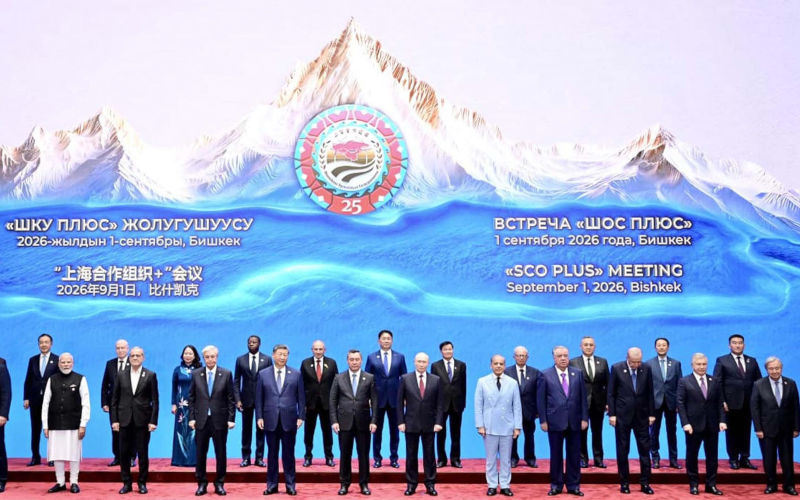
The Shanghai Cooperation Organisation (SCO) now represents 3.4 billion people and a quarter of global GDP, as its members seek a greater role in shaping a multipolar international order.
Despite a roll-up of all the ‘baddies’ in Western eyes, the latest meeting of the Shanghai Cooperation Organisation (31 August – 1 September) elicited little interest from the ‘white man’s media’. Even SBS, which would prefer to think itself distinct from such a moniker, could only describe the meeting in its evening news on Tuesday 1 September as “an Eurasian gathering”.
Chaired under its rotating chair structure, the Heads of State Council, the supreme governing body of the SCO, met under the leadership of the president of the Kyrgyz Republic, Sadr Japarov, in Bishkek, the capital of the Kyrgyz Republic, with the motto ’25 years of SCO: Together for a sustainable peace, development, and prosperity’.
Chief among those attending were Xi Jinping, Vladimir Putin and Narendra Modi. Notably present were Iranian President Masoud Pezeshkian and Alexander Lukashenko, the Belarusian president.
The current members of the SCO are China, Russia, India, Pakistan, Kazakhstan, Kyrgyzstan, Tajikistan and Uzbekistan, along with those who have joined recently, the Islamic Republic of Iran (2023) and Belarus (2024). It thus includes several states that have been at times in conflict: India–Pakistan, China–India, Kyrgyzstan–Tajikistan.
Observer states are Mongolia and Afghanistan, the latter currently with inactive status, along with 15 dialogue partners, the most prominent being Egypt, Turkey and Saudi Arabia.
Additionally, this summit included the participation of leaders from Azerbaijan, Armenia, Togo, Laos and Vietnam, with the secretary-general of the UN, António Guterres, along with ASEAN Secretary-General Kao Kim Hourn in attendance.
The SCO represents around 3.4 billion people and roughly 25 per cent of global GDP. Unlike NATO or the EU, however, as its founding document makes clear, it is neither a military alliance nor an economic union, but rather a forum for security cooperation, economic ties and diplomacy. Its founding declaration explicitly states the group is “not an alliance directed against other states”.
Despite its growing regional influence, the SCO again at this meeting emphasised its non-military character, affirming its members reject bloc-based and confrontational approaches to international and regional issues.
Still, its significance should not be underestimated. As the geopolitical scholar Halford Mackinder asserted in his well-known statement from 1904, “who rules Eastern Europe commands the Heartland; who rules the Heartland commands the World Island (Eurasia); who rules the World Island commands the world”.
Following the conclusion of the meeting, 28 documents were approved, including the Bishkek Declaration.
The declarations built on the previous Tianjin summit, which had laid out a decade‑long roadmap for the SCO around upholding sovereign equality, international law, including a call for multilateralism, and sustainable people‑centred development while contributing to a more just multipolar world order.
To that end, the Bishkek Declaration called for reforms to global governance, particularly through a stronger UN, so as to give countries a more equal voice in international decision-making.
Significantly, at a time when the US is threatening economic action be taken against any nations not assisting it in its economic sanctions directed against Iran, the SCO included in its Bishkek Declaration support for Iran’s sovereignty and territorial integrity, calling for the settlement of disputes through political and diplomatic means.
The declaration also commits the members to upholding the outcome of World War II, opposing attempts to alter history, seemingly a reference to Japanese claims on some of the Kuril Islands, while also being directed at Taiwan, which passed from Japan to the Beijing government in China at the conclusion of that war – an attempt, perhaps, to reinforce Beijing’s claim to the island as part of China.
Bishkek’s declaration turns the roadmap from Tianjin into an operational mandate, signalling that the organisation’s next phase will be judged less by declarations and more by delivery on specific programmes and platforms.
Beyond the main declaration, leaders signed more than 20 additional documents facilitating the bloc’s inner workings, covering security, drug trafficking, technology, transport, energy and environmental cooperation.
Whether the SCO can become a platform to forge a new international balance of power depends on whether it can move further from statements of intent to delivery. The Bishkek outcomes suggest a clear desire to do so.
The SCO, though ignored in much of the West, represents another sign of the fracturing of the old Western unilateral order, and the development of a different non-Western-led multilateral international order.
Another grouping representative of the fast-fracturing Western order, BRICS+, will meet on 12–13 September in New Delhi.
John Queripel is a Newcastle-based historian, theologian, social commentator and published author of four books. His latest book, ‘In Wisdom and in Passion: Comparing and Contrasting Buddha and Christ’. His examination of the Easter events, ‘On the Third Day: Re-looking at the Resurrection’ has just been re-printed. His blog may be found at www.johnqueripelblog.com.Substack / https://johnqueripel.substack.com’