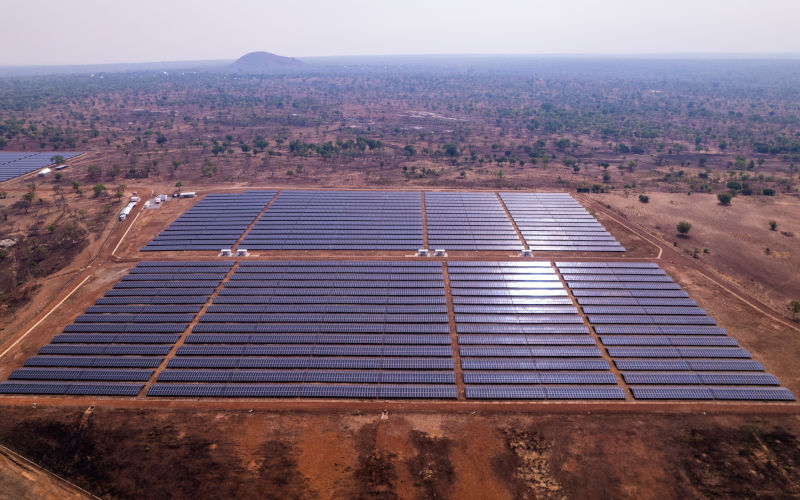
Solar panel imports are surging across Africa, but the global shift away from fossil fuels remains too slow. Meanwhile, Australian environmental groups unite behind ten principles to protect native forests, and a tiny wallaby makes a rare appearance.
African countries buying into solar
It’s difficult to know whether this story provides evidence that African countries are getting serious about installing solar energy or that their energy systems are so woefully underdeveloped because wealthy developed nations (most of which pillaged human, natural and financial resources from the continent during the last five centuries) have done little to help them take advantage of the rapid developments in renewable energy technologies. Both probably.
First the good news. Imports of solar panels to Africa from China (which produces 80 per cent of the world’s solar panels) have been increasing rapidly in recent years, with a 60 per cent increase in the 12 months to June 2025.
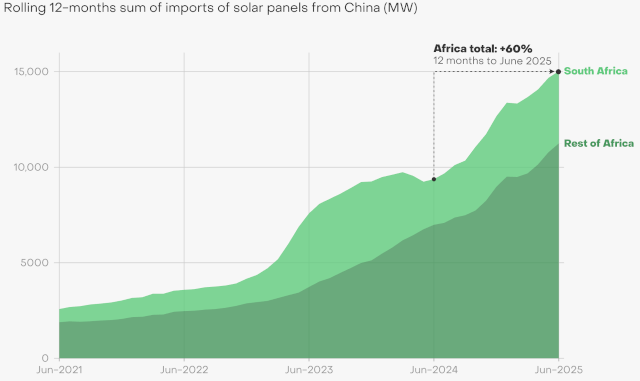
South Africa, Nigeria, Algeria and Egypt imported the most solar panel capacity but 27 countries set new records for their panel imports. It seems likely that most of the solar panels will be installed on the rooves of homes, shops, offices, factories and government buildings rather than in utility-scale facilities.
Twenty-five countries imported panels with electricity generating capacity of 100 MW or more. This will provide a considerable boost to electricity generation in many countries – over 10 per cent of current capacity in seven countries. Diesel imports will also be reduced and the savings can repay the cost of the solar panels in around six months (and improve people’s health).
Now the caveats:
- Total solar panel imports to Africa in the year to June 2025 amounted to 15,000 MW.
- The panels may not be put to immediate use. They may be put into storage or even re-exported.
With solar energy currently providing about 3 per cent of Africa’s electricity (and wind around 1 per cent), it’s going to be a while before Africa gets off fossil fuels.
Ten fastest evolving renewable energy countries
The ten countries shown in the graph below are the countries that are currently increasing the percentage of wind and solar energy in their electricity system at the world’s fastest rates – good to see an African country in there. Seven of them are well above the current global penetration of wind and solar of 17.4 per cent, which is almost equally split between the two.
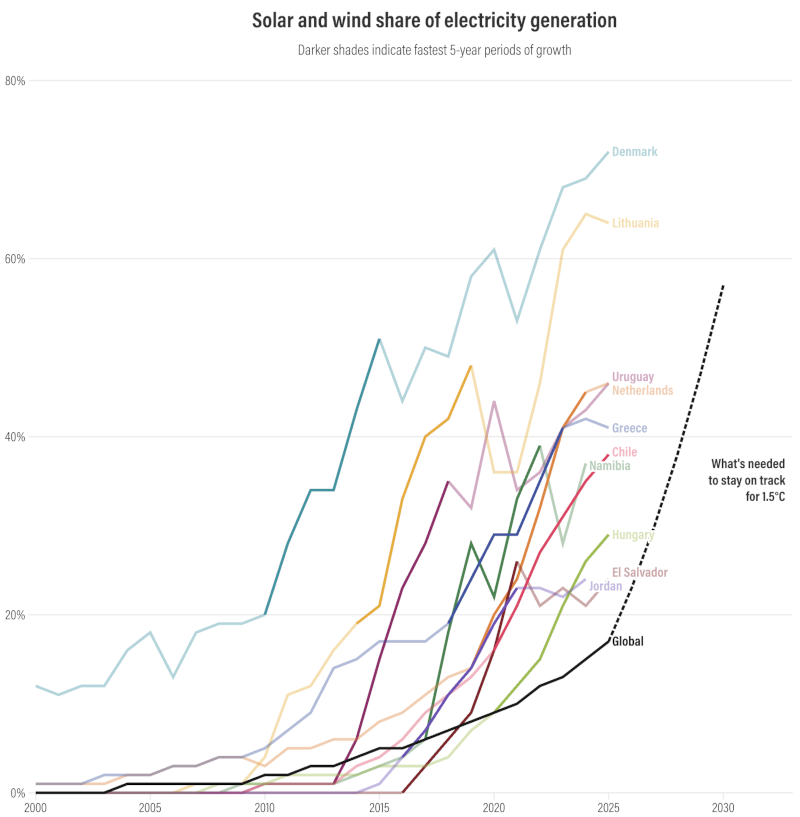
While the performance of these ten is impressive and shows that things can change quickly, unfortunately their relatively rapid deployment of renewable energy isn’t going to make much difference to the global average – their combined populations constitute approximately 1 per cent of the global population.
These 10 are not, of course, the countries with the most wind and solar energy capacity. Only 22 per cent of China’s electricity is generated by wind and solar but it’s a massive 2,300 terawatt-hours; even the US’s 19 per cent wind and solar produces 850 terawatt-hours. In addition, there are several large countries with higher percentages of wind and solar in their energy mix that have followed the tortoise’s winning strategy rather than the hare’s burn out (Spain and Germany are both over 40 per cent).
The simple fact is that the transition to renewable energy is gathering speed around the world because wind, solar and batteries are cheaper, cleaner and more flexible for many users. It is inevitable that renewables will eventually move beyond simply complementing fossil fuels to all but completely replacing them.
However, the consumption of fossil fuels is still increasing globally and there is little prospect of their use declining to close to zero in the next few decades, which is what is necessary to stop global warming. Plus, while the rollout of renewables in some countries is encouraging, it is still far too slow globally to make more than a marginal difference to the rate of decline of fossil fuels or, as shown by the dotted line in the graph above, keep global warming under 1.5°C, although that indicator seems rather ridiculous now.
We also need to remember that electricity accounts for only 22 per cent of final energy consumption globally, so there’s a lot of electrification that also needs to be done.
Ten principles to protect Australia’s native forests
Over 60 environment and climate groups have developed ten Forest Protection Principles to protect and restore Australia’s native forests. The vision sees an end of native forest logging and clearing, restoration of ecosystems, First Nations rights and leadership respected, and forests valued for the benefits they provide to people, wildlife and the climate. The agreed principles are:
- Immediate end to native forest logging on public land and permanent protection of forests.
- Uphold First Nations rights to free, prior and informed consent in public and native forest titles.
- Strong nationwide environmental laws to provide permanent protection for public native forests and protection for core habitats and climate refuges.
- World Heritage listing for Australia’s unique eucalypt forests.
- End deforestation across all public and private native forests.

- Restore forest ecosystems to recover biodiversity and carbon stocks and increase resilience.
- Ban the use of carbon and biodiversity offsets from public native forests.
- Ban burning of native forest biomass for energy.
- Stop native forest conversion to plantations and increase agro-ecological farm forestry.
- Restore and grow funding for the protection, conservation and restoration of native forests.
I can’t say that I’m a fan of the Improved Native Forest Management (INFM) method that has been approved by the Commonwealth and NSW governments but it’s possible that it will be a significant stimulus to ending native forest logging nationally.
The common factor behind Trump’s territorial aggression
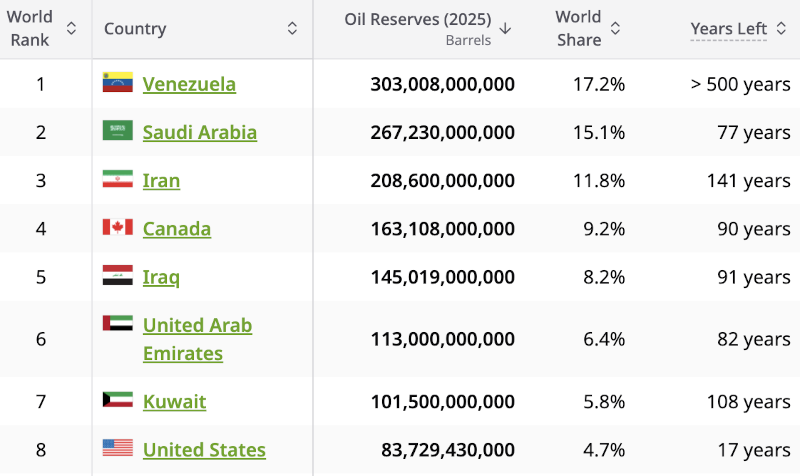
Venezuela, Iran and Canada hold almost 40 per cent of current oil reserves. Add Iraq and it’s getting close to 50 per cent. The other countries with more reserves than the US all host US military forces.
Greenland, another Trump target, has substantial deposits of critical minerals, including rare earth elements, uranium and industrial metals such as nickel, cobalt and copper.
Brazilians go to the polls shortly to elect their next president and, no surprises here, the US is sticking its grubby fingers into the close contest between the incumbent Lula and his predecessor’s son, Flavio Bolsonaro. Brazil has substantial reserves of many essential minerals including iron ore, niobium, manganese and bauxite, as well as offshore oil and gas and lots of forests and farmland.
To be fair, there’s no secret about the ambitions of Trump and his colleagues: what the US wants, what it doesn’t want, what it wants from others, and the principles and strategies it will use to get what it wants. It was all clearly laid out in the US National Security Strategy released last November. It’s worth reading.
If the document had been written by Russia or China, it’s impossible to imagine the panicky furore that would have ensued.
Australia’s second smallest wallaby is hanging on

This is a Narbalek, Australia’s second smallest wallaby. At 25 cm, it is not much longer than a sheet of A4 paper and weighing in at 1.2 kg, it’s about as heavy as a litre bottle of milk. Narbaleks used to be common in rocky outcrops across northern Australia but habitat loss, fires and invasive species, especially cats, have drastically reduced their numbers. Narbaleks are now hanging on in just a few pockets on offshore islands and in the Kimberley and NT. Sightings are few and far between.

Peter Sainsbury is a retired public health worker with a long interest in social policy, particularly social justice, and now focusing on climate change and environmental sustainability. He is extremely pessimistic about the world avoiding catastrophic global warming.