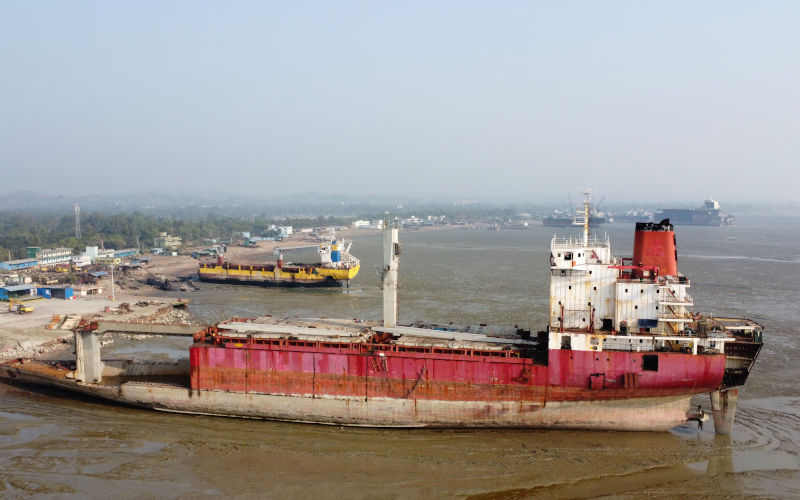
From devastating floods in the Northern Territory to the global failure to curb fossil fuels and the human cost of shipbreaking, environmental damage is accelerating – and hitting the most vulnerable hardest.
Climate catastrophes here and now in the NT
Most of my weekly titbits are based on statistical information about what’s currently happening or expected to happen as a consequence of climate change and destruction of our natural environment. But the consequences of our negligence are already having devastating effects on people’s lives.
This is well illustrated by Amanda Parkinson’s recent article, Collapsing from the Top, about the effects of the extensive and devastating floods that have brought displacement, misery and chaos to many in the Northern Territory since November last year.
The strength of Parkinson’s writing lies not in her descriptions of blocked roads, interrupted power supplies and inundated homes and town centres – we can see that on our TV screens. Rather it is her identification of who is most affected by the floods and who make up nearly all the residents of the evacuation centres – tick the box saying “Aboriginal families and communities” for both – and her descriptions of the conditions in the evacuation centres.
Most importantly, Parkinson asks, “Why the floods?” and “Why the appalling conditions in some of the centres?” In response, she points the finger straight at the NT government, aided and abetted by the Commonwealth government turning a blind eye when it suits them.
I don’t think that she ever uses the word “racism” in the article but it’s difficult to avoid the conclusion that this plays a considerable part in why Aboriginal communities are most exposed, most vulnerable and least able to cope.
For example, three-quarters of households in remote communities had their electricity supply disconnected at least ten times in a year; 90 per cent were disconnected at least once.
Such numbers do not represent individual poverty or fecklessness; they display callous disregard by the authorities for understanding what is going wrong at the local and policy levels and what needs to be done to fix it.
Parkinson also points out the incongruity of the NT already being one of the regions most affected by climate change and the Territory government aggressively pursuing policies that make the situation worse by rapid expansion of gas extraction – “doubling down on the industries driving the collapse”.
The NT’s priorities are well exemplified by the appointment last year of Stuart Knowles as the Territory Coordinator, “an independent statutory role established to champion transformative projects that fuel private sector investment, job creation, population growth, and industry advancement in the Northern Territory”. Knowles is a former executive of INPEX, a Japanese oil and gas company.
In some ways most shockingly, Parkinson describes not simply the overcrowded conditions in some of the temporary accommodation centres (that may, to some extent, be expected at least in the short term) but the dreadful ways in which the displaced Aboriginal people are being treated there – ten-foot fences around the centres, evacuees having to wear identity wristbands and sign in and out, locked showers with only cold water, not being allowed visitors without government approval, little control over access to food, medication or services, for example.
I’ll finish with Parkinson’s own words:
“This is the story of climate collapse in the Northern Territory. It is a story of class and race.
“The inequality is structural. It is poverty, concentrated in remote Aboriginal communities, where about three quarters of people live below the poverty line.
“The Territory’s budget depends on the poor staying poor. While successive governments speak of self-determination and thriving Aboriginal communities, the reality is different. It does not serve Darwin’s northern suburb voters, where most of the Territory’s budget is spent, for that to truly occur. Instead of reducing dependence on the Commonwealth, the NT government entrenches it.”
Renewables on the rise but so are fossils
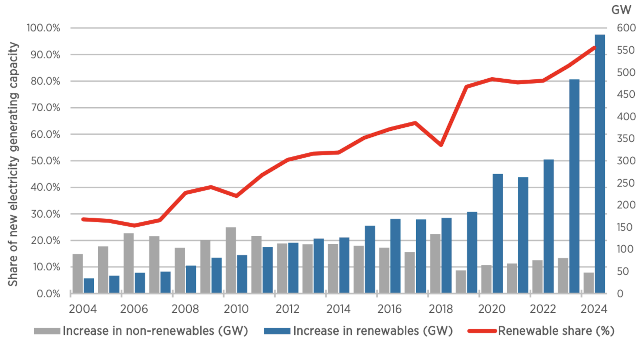
Globally, renewable power capacity is currently growing at about 15 per cent per year. In 2024, the global renewable power capacity was 4,448GW, representing 46 per cent of total capacity. Within renewables, in 2024 solar provided 42 per cent of capacity, hydropower 29 per cent and wind 25 per cent. Over three-quarters of the growth in renewables in 2024 was attributable to solar, which experienced a 32 per cent increase. Of the total growth in renewables capacity in 2024, China was responsible for 64 per cent.
The figure below provides a snapshot of the annual growth in capacity among non-renewables and renewables over the last 20 years and the share of all power provided by renewables.
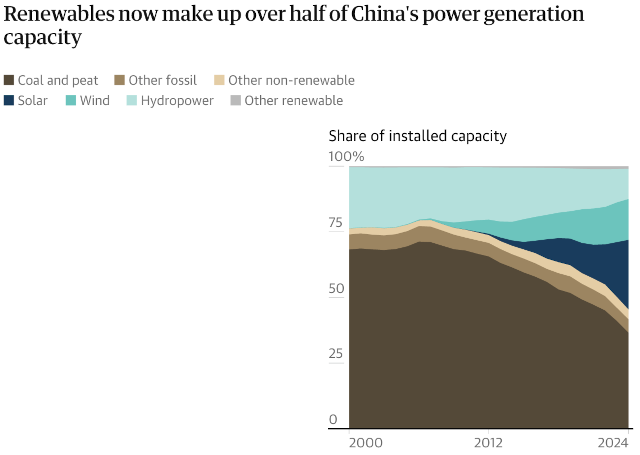
If we focus on China (where would we be in the global transition if it weren’t for China), the next figure demonstrates that in 2000 non-renewables, principally coal, provided marginally over three-quarters of all China’s power generation capacity, with the rest being provided by hydropower. By 2024, however, non-renewables had fallen to well under half of all power and solar and wind had surged.
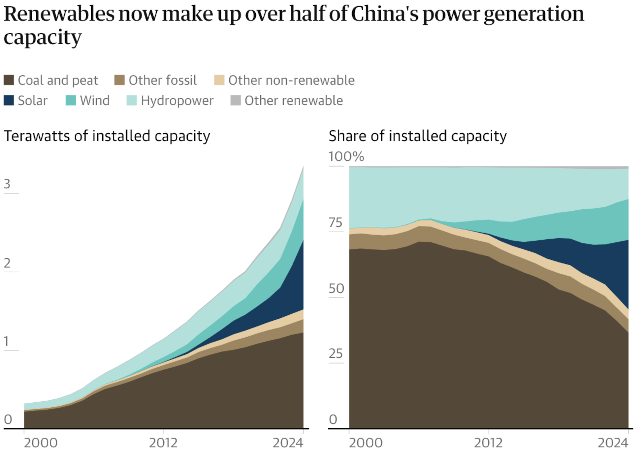
So far, so good, but all in the power garden is not quite so rosy as these data might have us believe. The unadulterated figure below now also displays the actual amounts of power capacity provided by each of the sources between 2000 and 2024. Renewables have increased by about 1.8 TW, which is great, but non-renewables have also increased considerably, by about 1.2TW, and the annual increase of non-renewables showed no signs of abating in 2024. This is the story that really matters for global warming.
Dangerous knackers yard for old horses of the sea

In 2025, 321 ships were dismantled piece by piece; by weight 85 per cent were dismantled on three beaches in Bangladesh, Pakistan and India. This will probably be the fate of many of the 68,000 ships that currently transport over 90 per cent of global trade, many of them ageing “dark fleet” vessels trading illicitly to avoid sanctions.
The doomed vessels are rammed at full speed into the beach at high tide. Local communities, who often depend on the industry as their only source of income, then go to work, with little occupational protection, dismantling the behemoths. Older ships contain toxic heavy metals, radioactive materials, asbestos and hazardous paints which, with any remaining oil, are washed away by the twice daily tides, with obvious consequences for the local marine and coastal ecosystems. Local villages also now flood more often because mangrove trees have been cut down to make space for the shipbreaking beaches.
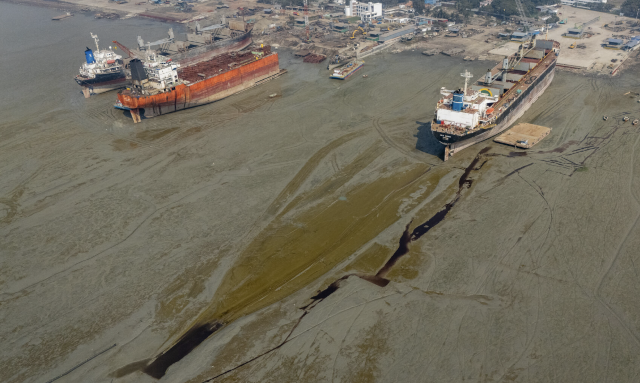
Not only is this terrible for the environment, it’s also bad for the health of the wreckers. The International Labour Convention calls it the most hazardous work in the world – that’s a big call because there’s some pretty determined challengers.
In 2025, 11 workers died and 62 were injured from falls, crushing and fires in South Asian shipbreaking operations, although many incidents no doubt go unreported. Many of the injuries lead to long term disabilities. All of the workers and local communities are exposed to a cocktail of toxic substances that cause, among other things, mesotheliomas and other cancers
A policy advisor at NGO Shipbreaking Platform says, “We are witnessing a system that is based on double standards, that is being built to serve an exclusively wealthy elite”. He refers to the largely unregulated and unsafe wrecking industry as “ a systemic global failure. A failure linked to the greed of mainly the Global North, that for money exports toxics to vulnerable countries. It’s a new form of colonialism. A toxic colonialism and toxic trade at its best. Until the fatally flawed beaching method of ships is banned, the weak health and safety laws and destructive environmental practices of South Asia’s shipbreaking yards will remain a dumping ground for the Global North’s toxic waste”.
Capacity vs Generation
I’ll finish by emphasising that the data I presented above concerned the capacity to generate power, not the actual power generated. Many power stations, renewable and non-renewable, in China and throughout the world, operate well below their capacity. And in fairness to China, I should point out that in 2025 coal-powered electricity generation fell by 1.6 per cent, even as demand increased by 5 per cent. This is what we need to see.
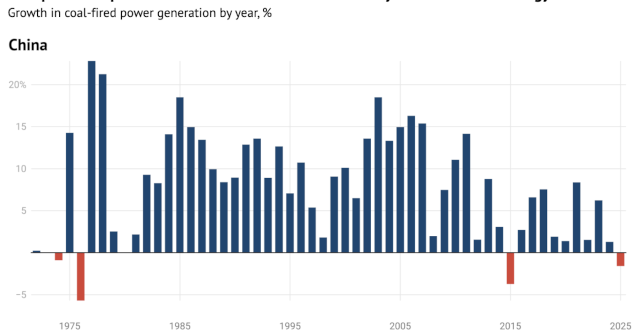
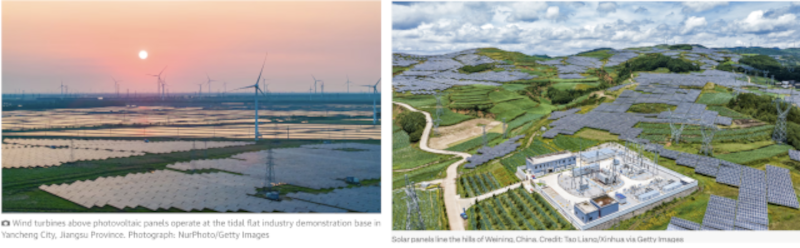
The photos below (left and right) suggest part of the reason why China is making the transition from fossils to renewables at unprecedented speed:

Peter Sainsbury is a retired public health worker with a long interest in social policy, particularly social justice, and now focusing on climate change and environmental sustainability. He is extremely pessimistic about the world avoiding catastrophic global warming.