Australia is subsidising rising diesel use, personal carbon footprints distract from systemic change, forest loss is accelerating and feral cats are killing even more native wildlife than we thought.
Our taxes subsidise diesel’s killing ways
Motor vehicles have as much interest to me as washing machines. We have one of each and, so long as they do their allotted jobs without inconveniencing me, that’s all I care about.
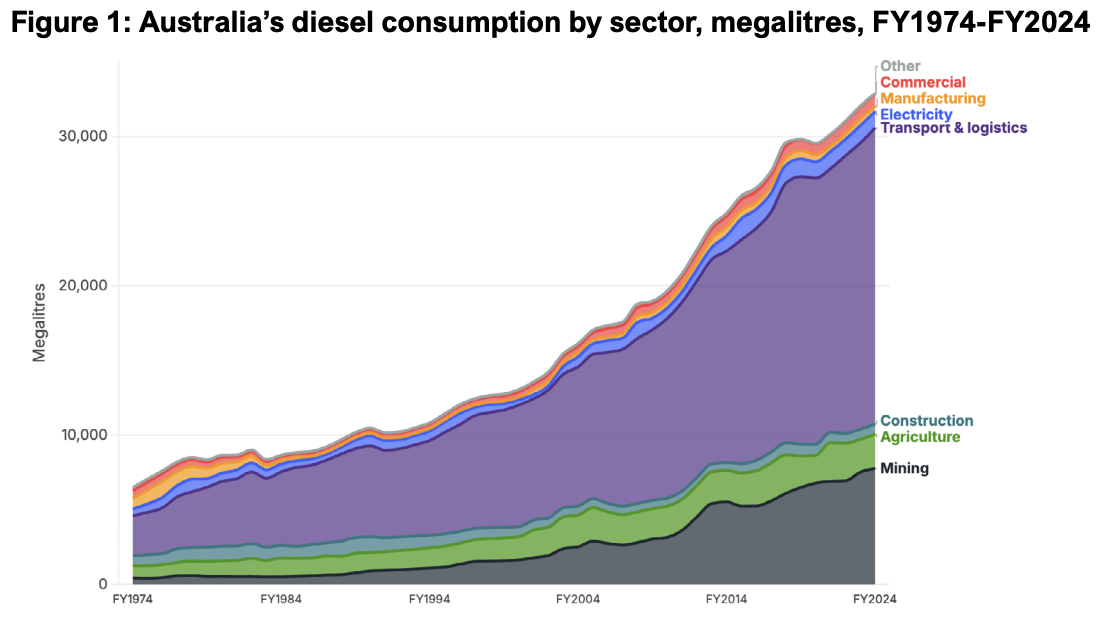
So it surprised me to learn that diesel consumption in Australia doubled between 2014 and 2024, mostly due to increased use in transport (see graph below).
Equally surprising is that diesel provides a fifth of Australia’s energy (more than electricity) and that Australia is the world’s largest importer of diesel and the leading per capita consumer. Freight burns up 45 per cent of our diesel, 90 per cent of which is on the roads, mostly burnt by articulated trucks. Passenger road vehicles and mining are also substantial users.
Although there are several short-term options available for reducing road freight’s diesel use (eg, eco-friendly driving, shorter vehicle turnover periods, better vehicle maintenance, payload optimisation, better route planning and fuel-efficient vehicles), whole-of-industry efficiency gains are probably capable of reducing diesel use by only 10 to 20 per cent. One problem is that, although they carry only 20 per cent of the freight, 80 per cent of trucking businesses are owner-drivers, who are least able and likely to make these changes.
Not only is all this a surprise, it’s also disturbing. Burning diesel releases greenhouse gases (GHGs), which cause more global warming, and the exhaust fumes are loaded with particulate matter and nitrogen oxides, both of which are dreadful for air pollution and human health. Australia should be eliminating the use of diesel as rapidly as possible, not increasing it.
To make matters worse, the Australian government is encouraging companies to use diesel via the Fuel Tax Credit Scheme, which currently costs the government about $11 billion per year. You and I are giving money to the government so they can pay businesses to kill us. Subsidising diesel consumption is like subsidising tobacco smoking. Worse, really. At least the people most at risk from smoking tobacco, the smokers, have some personal say in the matter. Air pollution harms everyone.
Air pollution from motor vehicle emissions in Australia has been estimated to cause about 11,000 premature deaths per year. If, for the sake of argument, we assume that all of these are caused by diesel exhaust, it’s costing the government $1 million to kill each one of those 11,000 victims. That’s about 50 times the going rate for a contract killing. If, as seems more likely, diesel causes only, say, 1,100 of those deaths per year, it’s costing the government an exorbitant $10 million per hit. Where’s the National Audit Office when you need them?
Let’s give personal carbon footprints the boot
In 2001, British Petroleum became Beyond Petroleum and in 2004 it hijacked the carbon footprint idea and spent millions of dollars to shift the blame for CO2 emissions from oil companies to individuals and families. The idea of calculating your own carbon footprint was, and remains, intuitively appealing to individuals who both want to do something good for the environment and are in a position to change some aspects of their personal consumption.
The carbon footprint story illustrates two competing explanations of social problems. The ‘i-frame’ focuses on the behaviours of individuals as the cause and emphasises individual actions to tackle the problem. The ‘s-frame’ looks to social policy and community conditions as the cause and sees system change as the essential element of corrective action. No prizes for guessing which framing of the problem (whether it be climate change or cigarette smoking or healthy eating or occupational health and safety or gambling) corporations promote in their public advertising and political lobbying.
But there are two major problems with the carbon footprint’s i-frame orientation:
- Not everyone is in a position to alter their personal carbon footprint. Telling a homeless, unemployed, single mother of two toddlers living in a disadvantaged neighbourhood to eat less meat and bicycle to the shops probably isn’t going to get much traction. Ditto a refugee in a war-torn developing country.
- Most GHG emissions are way beyond the control of individuals because they are built into the fabric of society: into power grids, food supply chains, transport systems, construction industry regulations and practices, national defence systems, etc. The decisions that determine the structures and operations of these systems are made in boardrooms and around cabinet tables (although it’s often difficult to see any difference), not in individual citizens’ heads.
According to environmental scholar Michael Manjates: “The sad truth about lifestyle environmentalism is that the living-green options on the menu are cumulatively puny when cast against the scale and speed of current assaults on the environment. So puny, in fact, that even if everyone on the planet did their best to live green, the cumulative impact still wouldn’t be anywhere enough to offset, much less reverse, the environmental destruction that’s now unfolding at a planetary level.”
Of course, the corporations that encourage the population to calculate their personal carbon footprint and take corrective action couldn’t care less whether GHG emissions are reduced or the environment more generally benefits. The longer they can convince governments and consumers that the i-frame is what matters, the longer the s-frame stays hidden and the longer they can keep generating their profits without any pesky green policies or consumer backlash.
Canada, Russia, Brazil and fires explain current forest loss
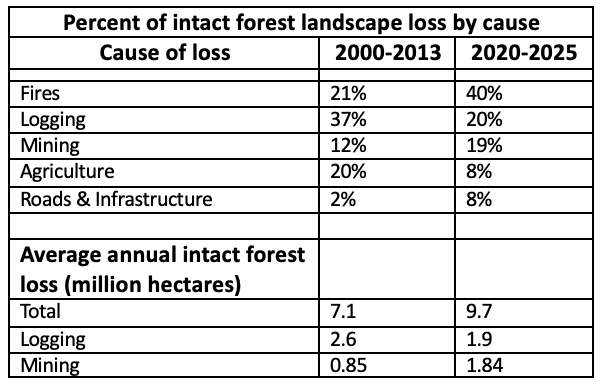
The table below compares the major causes of loss of intact forest worldwide in 2000–2013 and 2020–2025. It also displays the annual average hectares lost during each of these periods. In summary, the annual loss has increased by about 35 per cent and fires have taken over from logging as the major cause. Not only has logging’s percentage fallen, the actual area logged is also less. The area lost annually to mining has more than doubled.
The next figure demonstrates that 10 countries contain almost 90 per cent of all remaining intact forest (green bars). Canada, Russia and Brazil alone contain over 65 per cent of what remains and were the major sites of loss between 2000 and 2025 (brown bars).

Cats kill even more native animals than we thought
Many visual inspection studies of the stomachs and faeces of feral, domestic and stray cats have demonstrated that they kill more than 1.5 billion native Australian animals each year (over four million every day). But an analysis of the DNA of the contents of the stomachs of 71 feral cats shot or trapped in two remote areas of South Australia shows that this is a serious underestimate. The DNA analyses detected twice as many species (principally mammals and reptiles) and twice as many individual animals as the visual inspections.
The bar chart below compares the frequency of finding various animal species in the cats’ stomachs with each of the two methods. The message is clear: eradication of Australia’s feral cats is essential if we want to prevent more extinctions of our native fauna.

DiCaprio and Bezos provide US$200 million for endangered species
The Phoenix Species Project will try to save 100 animals and plants that are on the brink of extinction, including the delightfully named Hickory Nut Gorge green salamander from North Carolina, devastated by mudslides in 2024, and South Africa’s fuzzy belly button, a victim of its popularity as a houseplant in East Asia.

The editor and I have agreed that my environmental column will appear fortnightly in future. The next iteration will appear on 30 August.

Peter Sainsbury is a retired public health worker with a long interest in social policy, particularly social justice, and now focusing on climate change and environmental sustainability. He is extremely pessimistic about the world avoiding catastrophic global warming.