Christopher Nolan’s *The Odyssey* offers a warning for modern powers: military strength means little when nations abandon restraint, moral responsibility and shared humanity.
Defy the ancients and deny our shared humanity, and we risk the demise of civilisation.
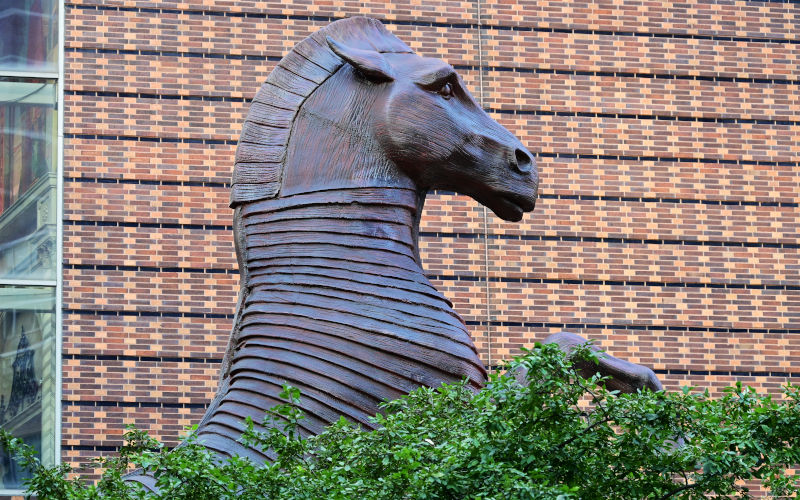
The centrepiece of The Odyssey is the Trojan Horse – Odysseus’s cunning victory over Troy. But in Nolan’s telling, the sack of Troy is not heroic triumph. It is one of the acts that seals Odysseus’s fate.
He has massacred combatants and civilians alike. He won the war, but victory leaves him traumatised by guilt. Why? Because, in Nolan’s moral universe, he has violated an ancient law: xenia – the sacred obligation of hospitality and respect toward the stranger and guest. The stranger may be a god in disguise. For Nolan, this Greek principle becomes a version of the Golden Rule – treat others as you would be treated.
The principle places a limit on power. Even when stronger, you cannot treat the weaker as less than human. Friend or enemy, combatant or civilian, there remains an obligation to recognise our shared humanity.
This makes Nolan’s Odyssey more than a war story. It is a meditation on the moral consequences of overwhelming power. Odysseus can defeat Troy militarily, but he cannot escape the human cost. His victory contains the seed of his destruction.
The film reads as an allegory of contemporary America – a critique not only of immigration policy but more broadly of American power exercised without sufficient regard for the humanity of those on the receiving end. The devastation in Gaza and ongoing violence involving Iran make this resonant. America may possess formidable military might and win battles, but military victory is not moral victory. Power can secure the battlefield while eroding moral legitimacy.
Empires rise and fall. Military overexpansion, economic crises and natural calamities hasten collapse. But Nolan offers a deeper explanation: the abandonment of the moral principles that bind humans together. A civilisation may remain powerful after losing its moral foundations, but eventually that decay becomes the decay of the empire itself.
This connects The Odyssey with Nolan’s earlier film Oppenheimer, which explored the atomic bomb and the terrifying possibility of human self-destruction. Today, that fear has a new dimension with rapid AI development. Unless humanity learns to co-operate and govern these technologies responsibly, destruction may come not from another civilisation, but from an intelligence we ourselves have created.
This August marks the 81st anniversary of the Hiroshima bombing. At this year’s commemoration, Prime Minister Sanae Takaichi reaffirmed Japan’s commitment to the Three Non-Nuclear Principles and called for a world without nuclear weapons. Yet Hiroshima’s legacy is about more than rejecting nuclear arms. It also represents Japan’s post-war rejection of militarism and commitment to peace after the Second World War.
Against that backdrop, Takaichi’s assertive security agenda has generated unease. Japan is strengthening its military in response to China’s rise and the US retreat from the global stage. Critics worry this shift weakens the pacifist spirit that defined Japan’s post-war identity.
For many across Asia, the memory of Japan’s wartime atrocities remains an open wound. The Nanjing Massacre and the Sook Ching massacre in Singapore are searing reminders of Imperial Japan’s brutality. In Nolan’s terms, these atrocities violate xenia – the obligation to recognise the humanity of the stranger, outsider, even enemy.
At one level, Takaichi’s military push is a strategic response to a changing region. But it raises a deeper question: what happens when a nation revises its past to downplay its wartime violence? That question looms over Japan’s ongoing Yasukuni Shrine controversies, which honour Class-A war criminals alongside war dead. This year, Takaichi sent an offering to the shrine – though she did not visit – while Defence Minister Shinjiro Koizumi and others did. Her 15 August address notably omitted explicit remorse for Japan’s wartime actions.
Here, Nolan’s Odyssey offers a striking moral lens. In the film, the ‘sea people’ are initially presented as barbarians threatening civilisation. But Nolan turns that assumption on its head: Odysseus and his men may regard themselves as civilised, yet their violence reveals the barbarism within them. The distinction between ‘civilised’ and ‘barbarian’ collapses. This may be Nolan’s most unsettling message for the modern world.
The United States, too, can become the ‘sea people’ – the powerful civilisation that believes its strength makes its actions legitimate. America is not alone in this danger. Japan, too, risks becoming captive to a narrative of itself as liberator rather than fully confronting its wartime aggression.
The real danger is not simply that powerful nations commit atrocities. It is that power creates moral blindness – the powerful no longer see themselves as capable of barbarism.
For Nolan, the test of civilisation is therefore not military strength or technological superiority. It is whether, even in the exercise of power, one remains bound by the ancient obligation to recognise our shared humanity.
Hiroshima reminds us that humanity possesses the power to destroy itself. Oppenheimer reminds us of the consequences of unleashing that power. The Odyssey offers another warning. Civilisations also destroy themselves when they lose the moral ability to recognise the humanity of those they regard as enemies.
Now, with AI developing at extraordinary speed, the stakes are even higher. We have created a new intelligence whose capabilities we do not fully understand. If humanity cannot learn to co-operate, restrain its ambitions and govern its creations responsibly, the threat may no longer come only from ourselves – it may come from something we have made.
The ancient warning remains as relevant as ever: defy the moral law, deny our shared humanity, and we risk losing not only our enemies – but ourselves.