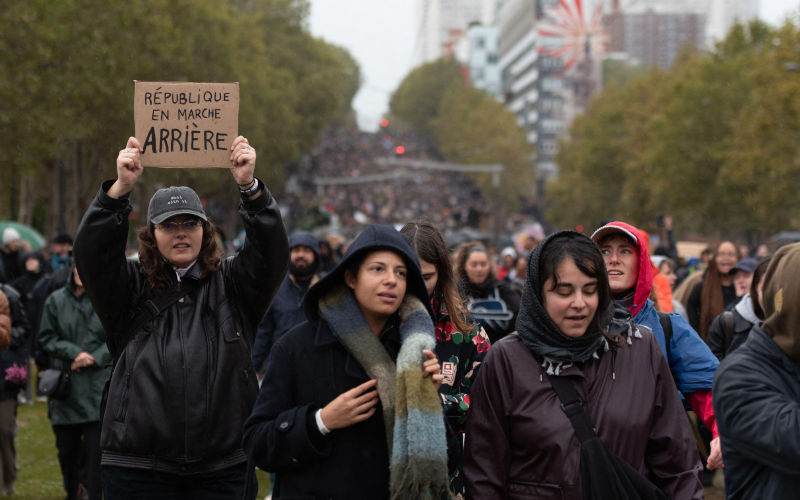
For some, protests bring solidarity and exhilaration. For others, the noise and intensity are unbearable. Staying away from the streets doesn’t mean caring any less about injustice.
Like most of you, I have been following the protests in France and I have been thinking about the revolutionary history of this country.
Australia has never had a revolution. I have never attended a protest.
Now you might think that this is because I am too caught up in my own world, or that I am not aware of my own oppression. But in light of my current employment, the opposite is true. So why haven’t I joined in protests connected to my exploitative employment conditions? For aesthetic reasons. I beg your pardon?
What is the defining attribute of a protest? Justice? Liberty? Equality? I would put it to you that it is noise. Yes, noise.
Let’s take a closer look.
A mass of people. Tightly packed together. Everybody shouting. Many people screaming. Some are yelling through megaphones. “What do we want? When do we want it? Now!” Another group are banging on something metallic. It is rowdy. It is boisterous. The whole purpose is to get noticed, to cut through. To draw attention to the problem. To make noise.
When I see a protest on the news I lunge for the remote control, so that I can turn down the volume. Does this make me a bad person?
For some people a street protest brings them an enormous sense of belonging, a feeling of collective effervescence and a cathartic sense of relief. As one young protester in Paris recently observed, “You can see everyone is mobilised, proud and happy to be here.” But for others, a protest is enervating. Writing about her withdrawal from street demonstrations in Melbourne, Grace Williams puts it this way:
[p]rotesting takes a large physical and mental toll for me. I have to spend days recovering from the long standing times, physical exertion and overstimulating environment that comes with the standard protest. That’s why I don’t go to most protests.
Here the very experience of attending a protest can exhilarate one person while overwhelming another.
Bourdieu’s ‘habitus’ and the boundaries of belonging
French theorist Pierre Bourdieu helps us to recognise how we actively help to bring about our own exclusion. This happens through our habitus, which is the way that we embody the environment we have been brought up in. For example, if you have been read to regularly as a child, you will feel much more at ease in a classroom than if the opposite were true. The same goes for attending a university, the opera or a state dinner. If you were not brought up with parents who went to university or exposed you to classical music and table manners, you will think, “This is not for the likes of me”. For Bourdieu, the self-exclusion that results from this habitus is what keeps society intact and stable and explains why people do not try and rise above their own class. Bourdieu’s great insight was that this is not a conscious rational process, but rather an intuitive embodied one.
But what happens when two people from the same family attend a public protest with similar educational backgrounds and political convictions? Whereas one person feels entirely at home and is stimulated by the shouting, chanting and collective energy of the crowd, the other person feels profoundly uncomfortable and knows in their bones that they do not belong there. Yet this discomfort has little to do with political convictions or social background. It is the experience itself that they find overwhelming.
‘Aesthetic susceptivity’ and an intolerance of noise
This is where Bourdieu’s habitus needs to be supplemented by what I call aesthetic susceptivity: the extent to which the sensory world around us shapes how we participate in social life. Aesthetic susceptivity can result in a heightened sensitivity that leads to exclusion, but which cannot be explained through the habitus of class, education or upbringing.
In the 19th century, the irascible German philosopher Schopenhauer wrote a short treatise on noise, connecting its toleration directly to intelligence:
The general toleration of unnecessary noise – the slamming of doors, for instance, a very unmannerly and ill-bred thing – is direct evidence that the prevailing habit of mind is dullness and lack of thought.
Here Schopenhauer’s intolerance of “unnecessary noise” becomes a moral judgement: those who are indifferent to it are inferior and unintelligent. And Schopenhauer’s intolerance of noise was extreme. Hammering, barking dogs and the “screaming of children” were abominable, but nothing disturbed him more than the cracking of a labourer’s whip in the street:
No sound cuts so sharply into the brain as this cursed cracking of whips [which] must be regarded as something purely wanton; nay, as an impudent defiance, on the part of those who work with their hands, offered to those who work with their heads. That such infamy is endured in a town is a piece of barbarity and injustice …
His aversion to noise was clearly entangled with class prejudice. Schopenhauer resented that a labourer could interrupt the thoughts of a philosopher. We can also imagine that he would have taken a similarly dim view of noisy protesters. In this respect, Bourdieu’s theory of habitus helps explain his response.
What Bourdieu’s habitus does not fully account for is the way people’s different sensory perceptions help to shape their worldview. For instance, consider how Schopenhauer’s revulsion to “unnecessary noise” meant that he did his thinking behind tightly closed doors, whereas his predecessor Socrates actively sought out public discussion in the bustling Agora of ancient Athens. Whereas Schopenhauer found the experience of being disturbed by noise a sensory violation, Socrates went out of his way to add to this disturbance, saying: “I am that gadfly which God has attached to the state, and all day long and in all places am always fastening upon you, arousing and persuading and reproaching you.” For Schopenhauer, it was a moral obligation not to disturb the intellectual lives of others; for Socrates, it was a moral obligation to disturb them.
What I find most interesting is how their contrasting forms of aesthetic susceptivity became intertwined with their moral convictions. It is not hard to see how contemporary public protesters might regard themselves as modern gadflies.
The cultural influence of aesthetic susceptivity
But why concentrate on these two long-dead philosophers? Why not look at contemporary social activists and public protesters? To understand our cultural attitudes towards the world around us, we need to examine the thinkers and artists who helped shape them. Their lives and work provide unusually vivid and influential accounts of how people experience and respond to their sensory and emotional worlds. In the past, this aesthetic susceptivity might have been praised as an ‘artistic sensibility’ or dismissed as ‘neurotic’ or ‘overly sensitive’. But the recent, growing recognition of neurodiversity has challenged these judgements, encouraging us to understand such differences as variations in how people experience the world rather than simply as personal deficiencies.
Nevertheless, this does not mean we need to take Schopenhauer’s association between intelligence and intolerance of noise as the final word. For instance, James Joyce is often cited as being the greatest writer of the 20th century and he had a very different aesthetic susceptivity to noise and other sensory disturbances.
Due to the dire financial circumstances he experienced after exiling himself to Europe, Joyce used to write in the middle of the living room in a crowded city apartment, surrounded by his children playing and the noise coming from the street. This never seemed to bother him. In fact, Joyce famously incorporated the sound of a modern environment into his work. This is from Ulysses (1922): “Right and left parallel clanging ringing a double-decker and a single-deck moved from their railheads”. Sights, textures, sounds and especially smells also suffused his writing: “Stale smoky air hung in the study with the smell of drab abraded leather of its chairs”.
What Schopenhauer and Joyce share is a heightened aesthetic susceptivity, but there is an important distinction between sensory sensitivity and sensory intolerance. You can be acutely aware of your sensory surroundings and find them invigorating, or you can experience them as overwhelming and do everything possible to escape them.
Embodied sensitivity and Proust’s retreat
I have suffered from hyperacusis for most of my life, a condition that makes certain sounds physically painful, especially in relation to a modern urban environment. I would liken the sound of coffee machines grinding beans, ute drivers revving their engines, people shouting over astringent music in cafés to having someone drilling into an exposed nerve ending in your teeth. At the same time, hyperacusis has given me a heightened appreciation for nature, where I feel I can almost hear every grass blade rustling in the breeze and the dew drops falling to the ground. It has also made me wonder if this is a purely adult development or something that I have always had, an aesthetic susceptivity that has grown more extreme with age. The one thing that is clear is that this kind of embodied sensitivity cannot be explained simply through class, gender or race; it is another dimension of human experience that cuts across these categories.
In my own life I have come to recognise that my attraction to the writing of Marcel Proust is driven by the fact that the author makes intimate connections between the sights, sounds, smells and the moral and emotional atmosphere of the world around him. In Swann’s Way (1913) Proust famously made this connection come alive when he dipped a piece of madeleine cake in lime-blossom tea that his aunt used to give him when he was young:
But at the very instant when the mouthful of tea mixed with cake crumbs touched my palate, I quivered … a delicious pleasure had invaded me … it had immediately rendered the vicissitudes of life unimportant to me, its disasters innocuous …
For Proust, heightened aesthetic susceptivity could make the difficulties of life more tolerable. Yet his relationship with the outside world was more complicated. Where Joyce immersed himself in the sounds of everyday life and Schopenhauer sought to control his environment, Proust increasingly retreated from the noise and dust of Paris. He lined his bedroom with cork and wrote throughout the night, absorbing himself in sensory memories from the past. It took him 13 years to write his epic seven-volume tome, In Search of Lost Time (1913–27), and he did so in almost complete seclusion, dying before the last three volumes were published.
Proust’s withdrawal from the world did not mean that he was indifferent to it. In The Guermantes Way (1920–21), he describes speaking to his grandmother over the telephone. Without the familiar expressions of her face, Proust becomes acutely aware of the sweetness and sadness of her voice, recognising for the first time “the sorrows that had scarred it in the course of a lifetime”.
An even more revealing episode occurs in Swann’s Way, when Proust recalls how his great-aunt deliberately encouraged his grandfather to drink brandy, knowing how much this distressed his grandmother. The young narrator was so infuriated by this cruelty that he wanted to strike his great-aunt but instead retreated upstairs to cry alone. Here Proust recognised his own cowardice but found the spectacle of his grandmother’s humiliation unbearable. His response illustrates how a heightened sensitivity to injustice can produce withdrawal rather than action. Where Joyce embraced the sensory world and Schopenhauer judged it, Proust was simultaneously fascinated by it and yet felt compelled to retreat.
The paradox of protest
This brings us back to what it feels like for many to attend a protest. To be surrounded by hundreds or thousands of people expressing their anger, frustration, fear and distress so openly and intensely can be overwhelming. What others experience as collective solidarity and emotional release can become a painful exposure to a collective raw nerve.
Reporting on an earlier French demonstration, one journalist described a “sensory overload“, with streets reverberating to “noise, smells, voices and evocative sights”, including the “cacophonous booms of thunderclap fireworks”. More recently, Eline, a 23-year-old attending her first demonstration in Lille, complained: “We got gassed even though we weren’t doing anything.” The march had been engulfed in an “opaque, stinging haze” of tear gas that left her eyes full of tears. All this would have tested the limitations of Proust’s cork-lined Parisian apartment if he were still alive. It would have also sent Schopenhauer and Joyce out into the streets, the former in a furious rage, the latter to immerse himself in the sensory spectacle.
We might mistake the exhilaration of collective action for political commitment, just as we might mistake an aversion to it for indifference or cowardice. What appears to be a difference in moral character might instead be a difference in aesthetic susceptivity.
Like Socrates, protesters play an essential role in disturbing the established order, challenging complacency and forcing society to confront uncomfortable truths. But recognising the necessity of such disruption should not prevent us from recognising how its intensity can exclude those who feel injustice deeply. In fact, the paradox inherent in protest attendance is that the very sensitivity that makes someone acutely aware of suffering and injustice can also make it difficult for them to participate in collective action against that injustice.

Adrian Rosenfeldt
Dr Adrian Rosenfeldt teaches at Melbourne University. He is a journalist, public speaker and the author of The God Debaters: New Atheist Identity-Making and the Religious Self in the New Millennium (2022). www.adrianrosenfeldt.com