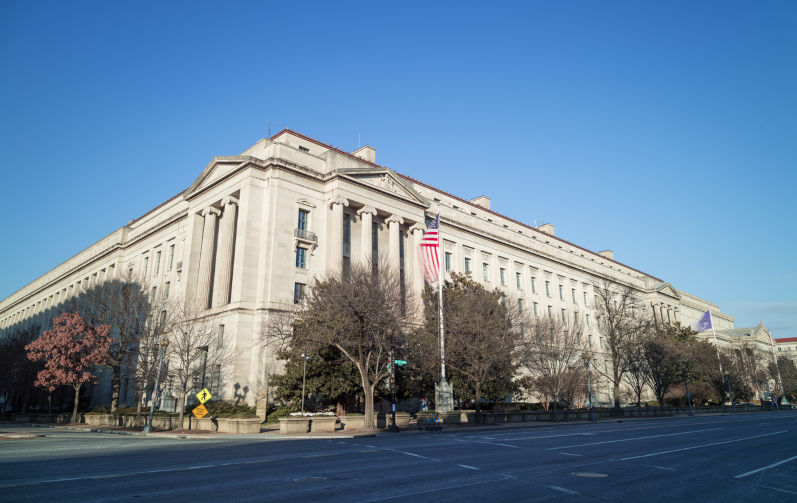
Donald Trump has sidelined professional diplomats, left embassies vacant and elevated ideological loyalists, weakening the State Department and making US foreign policy more coercive, erratic and dangerous for allies.
Created in 1789, the State Department is the oldest organ of the United States federal government. Six of its secretaries, including Thomas Jefferson, James Madison, James Monroe and John Quincy Adams, went on to become president. In more recent times, several other secretaries have been highly influential in the development of US foreign policy, including George C Marshall, Henry Kissinger, Madeleine Albright and Hillary Clinton.
Over 36 years in the Australian Foreign Service, I came to appreciate the professionalism, objectivity and impartiality of many American State Department colleagues in various countries where we shared diplomatic posts. We frequently exchanged views, and I often sought their advice because, with larger staffs, they had the capacity to examine economic and political issues in greater depth than could we in our embassies.
For several reasons, I doubt that I would do so today. First, President Donald Trump has shown contempt for professional diplomats during his second term in office and has trashed the State Department. Diplomats who remain in the department or serve overseas are no longer encouraged to offer candid advice that may offend the president. They are prone to self-censorship in what they say and report. They are also required to report on people in their host countries who make such statements.
Second, Trump has appointed a prejudiced and unqualified outsider, Marco Rubio, as his secretary of state. Rubio’s predecessors during Trump’s first term – Rex Tillerson and Mike Pompeo – were marginally more liberal and open-minded about some issues. But with Trump’s backing, Rubio follows an ‘America First’ agenda which prefers coercion over negotiation in United States dealings with other countries, even with erstwhile close allies. Rubio has claimed that his parents were forced to leave the country after Castro ousted Batista in 1959, obfuscating the inconvenient fact that they had voluntarily left for the United States during Batista’s reign. Rubio has evinced an abiding hatred of the Cuban government, as well as of other left-leaning governments, particularly in Central and Latin America.
Third, as of June 2026, more than half of US ambassadorships abroad have been left vacant. And of those Trump has appointed during his second term, only nine out of 101 nominations have been career diplomats, as is customary in the US. The rest have been right-wing business associates and cronies, including David Brat, Washington’s new ambassador to Australia. A former Republican congressman, Brat has a master’s degree in Divinity from Princeton’s Theological Seminary and is said to want to ‘synthesise’ Christianity and capitalism.
The scorn Trump shows towards professionals and their regional expertise has left State Department veterans aghast and has weakened US authority abroad. Not since Joseph McCarthy’s ‘Red Scare’ in the 1950s has there been such dismissiveness of professional diplomats. One consequence was that the unqualified Steve Witkoff and Trump’s son-in-law Jared Kushner were completely outplayed by a well-prepared team of Iranian professionals in Islamabad when they attempted to negotiate the June 2026 memorandum of understanding designed temporarily to halt hostilities between the US and Iran.
One of the most exaggerated documents recently put out by the State Department was an unsigned 100-page report entitled Cuba – the Capital of 21st Century Communism, published on 20 July 2026. It baldly asserts that although Cuba is not strong enough to defeat the United States in a conventional armed conflict, it has perfected a long war of attrition. Cuba has organised espionage, sabotage, proxy networks and a revolutionary infrastructure designed to turn America against itself. It has infiltrated the State Department, National Security Council and the Pentagon with agents at the top level. It has trained and armed tens of thousands of left-wing guerrillas to create violent insurgencies that have plunged multiple continents into chaos. It has backed extremist attacks across the United States, and recruited, cultivated and mobilised a global network of intellectual activists. It has shaped a disproportionate share of America’s most influential extremist groups. Its raison d’être has been the violent export of communism abroad, especially to the United States.
The majority of the 9.5 million hungry and poor citizens of Cuba would be amazed at this exaggeration of their country’s influence. Cuba’s regional influence, once potent, has recently shrunk to include Nicaragua, Bolivia and Colombia, with some residual influence in Africa and the Middle East. It still belongs to the extant group ALBA, the Bolivarian Alliance for the Peoples of Our America, founded by Castro and Chávez in 2004. But the United States, which in 2004 failed to keep alive its rival group, the Free Trade Area of the Americas, maintains a much more extensive network of bilateral trade relations across the continent.
As I suggested in ‘Will Cuba be next‘, published in P&I on 28 September, Trump may use the indictment of Raul Castro by a grand jury in Miami as a reason to launch an attack on Cuba. The State Department’s Cuba – the Capital of 21st Century Communism provides a much more cogent, if highly exaggerated, reason. As suggested by Consortium News, Trump continues to lay the groundwork for dictatorship. Before long, US elections may be sabotaged in the name of ‘national security’, left-wing dissent criminalised in the name of ‘combating terrorism’, democracy snuffed out in the name of ‘protecting freedom’.
In such a situation, despite the Australian government’s rejection of the US Cuban embargo, our stubborn adherence to our great and powerful friend seems increasingly dangerous and unrealistic. Our campaign for a seat in the UN Security Council should take that into account.
Richard Broinowski AO is a former Australian diplomat, general manager of Radio Australia and adjunct professor at the Universities of Canberra and Sydney. He has published eight books, the latest being an expansion of his 2003 book Fact or Fission – the truth about Australia’ nuclear ambitions. The later edition includes extra chapters on Australia’s intention to acquire nuclear-powered submarines. (Scribe 2022). Richard Broinowski was a senior Australian diplomat who served in Iran in the 1970s and the Australian Ambassador to Cuba in the mid-1990s.