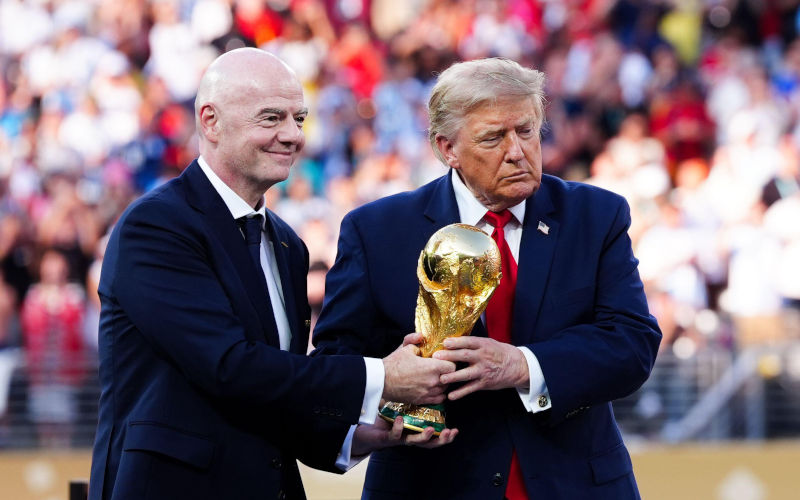
The World Cup presentation with Donald Trump and Gianni Infantino revealed how FIFA converts football’s collective wealth into patronage, reducing supporters to customers and participation to spectacle.
There was something revealing in the way FIFA President Gianni Infantino attended to Donald Trump during the presentation of the World Cup.
He hovered beside him, guided him through the ceremony and appeared to manage his reluctance to surrender the stage to the players who had actually earned it. Trump looked less like the leader of the host nation than an overindulged child being supervised by an exceptionally attentive minder.
At first glance, it appeared to show FIFA submitting itself and the world game to American political power. But Infantino was not simply looking after Trump. He was looking after FIFA’s investment in Trump.
Trump needed to occupy the stage. Infantino needed only to stand beside the man who occupied it. Of the two, Infantino may have better understood how power works.
Perhaps FIFA had not merely been captured by American political power. Perhaps it had become exceptionally skilled at capturing political power through flattery.
The presentation culminated a relationship cultivated well before the tournament. Infantino repeatedly placed himself within Trump’s political orbit, while FIFA created its first Peace Prize and awarded it to him. During the World Cup, Trump intervened after United States forward Folarin Balogun received a one-match suspension. FIFA placed the penalty on hold.
Sporting integrity depends upon a belief that the same rules apply to everyone. The apparent influence of presidential access was therefore damaging in itself. It also exposed a familiar hierarchy: FIFA moved quickly for a powerful political leader while complaints from Palestinian football authorities disappeared into legal complexity and procedural delay.
But blaming Infantino alone would mistake the president for the institution that produced him.
FIFA’s transformation accelerated after João Havelange became president in 1974. Television rights, corporate sponsorship and expanding competitions turned a modest federation into the proprietor of one of the world’s most valuable cultural products.
Sepp Blatter refined the system until football development and political patronage became difficult to separate. The 2015 arrests exposed a decades-long network of bribery, kickbacks, fraud and money laundering.
The scandal revealed more than corrupt individuals. FIFA’s structure had made patronage an effective method of governing it.
I had encountered a glimpse of this much earlier. As a young coach, I once asked why prominent people from outside football were so interested in leadership positions within its international administration. The answer was delivered almost casually: FIFA membership was a gateway to international trade.
Only later did I understand. Football provided entry into a network of governments, corporations, broadcasters and commercial opportunities. FIFA controlled not only tournaments, but access.
Australia later spent approximately A$46 million pursuing the 2022 World Cup and received one vote – an uncomfortable illustration of the system’s real hierarchy.
After 2015, FIFA introduced term limits and supposedly independent ethics mechanisms. Yet its governing relationships remained substantially intact.
FIFA generates and distributes football’s wealth, enforces its rules, selects tournament hosts and investigates its own conduct. Meanwhile, its member associations decide whether the president remains in office.
Many smaller associations depend upon FIFA funding. The assistance can be genuine and valuable, but those deciding the president’s future receive money, appointments and access through the institution he controls.
This does not mean every grant purchases a vote. Patronage rarely requires an explicit bargain; it works through dependency, accumulated obligation and an understanding of where future benefits originate.
The circuit is durable. Football produces commercial wealth; FIFA’s leadership distributes part of it to associations; their delegates return the leadership to office, preserving its authority over the next distribution.
Reform changed rules without changing the relationships that made the system work. The language improved and the money continued to circulate. So did the power.
It would be comforting to regard FIFA as an exceptionally corrupt organisation operating beyond democratic values. But its transformation accompanied the rise of governments that transferred public functions to markets, weakened constraints upon concentrated wealth and treated commercial success as evidence of institutional virtue.
FIFA learned these lessons well. It converted a common cultural inheritance into an exclusive commercial product. Governments and taxpayers supplied stadiums, transport, security and legal concessions, while FIFA controlled the principal commercial revenues. The public carried much of the risk; FIFA captured much of the value.
Political equality formally remains, but wealth increasingly determines who can purchase access, shape public discussion and construct electoral machinery.
In American politics, private wealth flows towards candidates whose success may provide access and influence. In FIFA, institutional wealth flows towards associations whose votes sustain the leadership controlling it. The two systems move money in opposite directions.
Neither arrangement needs an explicit bargain. The structure itself creates dependency, obligation and unequal influence.
In both systems, those at the base retain formal participation. Citizens vote; supporters buy tickets, subscriptions and memberships. But the conditions are designed elsewhere by people with far greater control over money, access and information.
The citizen becomes an electoral customer. The supporter becomes a football customer. Both retain the right to choose while losing much of their capacity to govern.
FIFA is not an aberration from the neoliberal political order, but a concentrated expression of it: collective wealth converted into private authority, public purpose colonised by patronage, and formal democracy preserved after much of its substance has drained away.
Replacing Infantino would not be enough. A healthy institution cannot depend upon finding a virtuous president; its structure must make abuse visible and consequential.
FIFA must separate the distribution of money from the election of those controlling it. Democracy must restrain the conversion of concentrated private wealth into disproportionate political power. Both need independent institutions and forms of participation that give their nominal owners influence between votes.
The answer is not to abandon democracy, any more than supporters should abandon football. It is to reclaim both from those who have converted participation into spectatorship.
The image of Trump and Infantino captured what has been lost. Two men stood at the centre of something created by millions of others. Behind Trump stood private wealth converted into political influence. Behind Infantino stood football’s collective wealth converted into institutional patronage. Before them were the players; around them, the supporters. Yet the two administrators of power appeared most reluctant to leave the stage.
The health of democracy and football depends upon the same principle: those who create and sustain an institution must retain meaningful power over it.
Football remains the world’s game. Democracy remains the people’s government. Neither claim will mean very much until the people recover the authority to make it true.

John Frew worked in public education, including as foundation principal at a secondary school for students with Conduct Disorder and Oppositional Disturbance. John has authored numerous books the latest being ‘Neuroscience and Teaching Very Difficult Kids’. Since retiring, he has continued to comment on social issues.