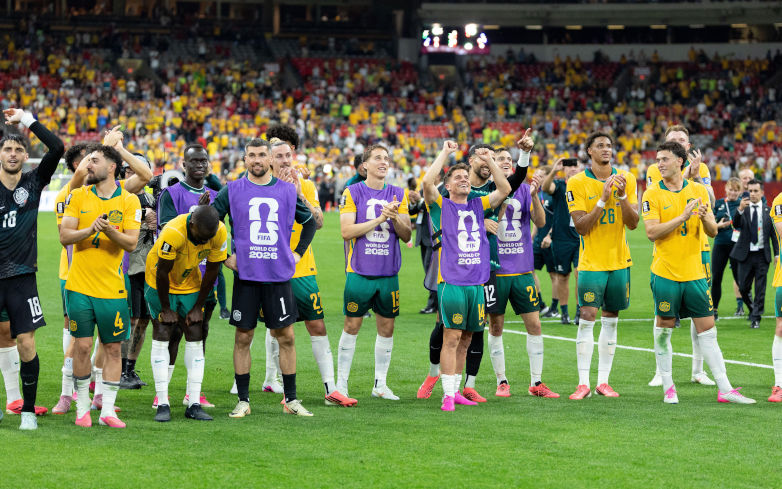
The Socceroos’ success is more than a sporting story: it is a reminder that the children of migrants and refugees are not outsiders to Australia’s future, but part of the national story itself.
As the final whistle sounded, celebrations erupted across Australia.
Thousands gathered in Federation Square. Pubs overflowed with supporters wearing green and gold. Clubs stayed open long after the match had finished. Families crowded around televisions in living rooms from Perth to Brisbane. Complete strangers embraced. Flags appeared from nowhere. Car horns sounded into the night.
The victory mattered, of course. But the emotion seemed larger than the result itself. For a brief moment, people who would never meet one another, who lived in different suburbs, worked in different occupations and held different views about almost everything, felt part of the same story.
They belonged.
Perhaps that is why sport continues to exert such a powerful hold on us despite the growing commercialisation that surrounds it.
Administrators can sell broadcasting rights. Investors can buy clubs. Sponsors can place their logos on every available surface. Yet beneath all of this remains something stubbornly human. People are not really searching for entertainment. They are searching for connection.
The modern Socceroos are, in many ways, a reflection of contemporary Australia itself. Their stories begin in different countries, different cultures and, in some cases, circumstances few Australians can easily imagine. Some are the children of migrants. Some are the children of refugees. Some spent their earliest years in refugee camps or arrived after their families had escaped war, persecution and upheaval.
Their journeys could hardly be more different.
Their destination is the same.
Much of our political debate about refugees is conducted in the language of threat and risk. Yet behind those debates sit individual lives and individual stories. Awer Mabil was born in a refugee camp in Kenya after his family fled South Sudan. Mohamed Touré was born in Guinea after his Liberian family escaped civil war. Nestory Irankunda was born in a refugee camp in Tanzania before arriving in Australia as a child and later became the youngest Socceroos goal scorer at a World Cup. Milos Degenek arrived after his family experienced the upheaval of the Balkan conflicts.
There is a tendency to discuss refugees through the language of politics. Yet the stories of the Socceroos remind us that belonging is not something people bring with them. It is something that is created over time.
For generations, people have arrived on these shores seeking safety, opportunity and a future for their children. Italians and Greeks arrived after the war. Vietnamese refugees arrived following the fall of Saigon. Families escaping conflict in the Balkans built new lives here. More recently, communities from Africa, the Middle East and Asia have added new threads to the national fabric. There is an irony here that is difficult to ignore. At a time when migration and multiculturalism have become increasingly contentious political issues, some of Australia’s most celebrated sporting heroes are the children of migrants and refugees. Their stories do not resolve every policy debate, nor should they. But they do serve as a reminder that today’s newcomers are tomorrow’s Australians.
The result is visible everywhere we choose to look, in our suburbs, our workplaces and our schools. It is visible in the doctors, teachers, tradespeople and business owners who quietly contribute to Australian life every day. Yet behind the footballers who attract our attention stand thousands of less visible Australians whose stories follow a similar path, whose lives have become inseparable from the life of the nation itself.
It begins when families settle into unfamiliar suburbs and children walk through the gates of a local school for the first time. It unfolds in workplaces, sporting clubs and community organisations. It appears in friendships formed across cultures and in neighbourhoods that gradually become home.
Over time, the extraordinary becomes ordinary. The family that once seemed new simply becomes part of the community. Children grow up with Australian accents. The local football team acquires a few unfamiliar surnames. New food appears at the school fete. New words enter the local vocabulary. New traditions sit comfortably alongside old ones. Life moves on, and looking back, it is difficult to imagine the community without them.
Australia’s history is full of stories like these. Italians, Greeks, Vietnamese, Croatians, Lebanese and countless others arrived carrying memories of another place and hopes for a better future. More recent generations have followed a similar path. Different journeys. Different cultures. Different circumstances. Yet the story that follows is often remarkably familiar.
The country that offered an opportunity gradually becomes home.
Perhaps this should not surprise us. Those who have experienced the loss of one homeland often develop a deep appreciation for another. People who have searched for somewhere to belong rarely take belonging for granted once they find it. They invest themselves in their communities, contribute to the society around them and, over time, become part of the national story itself.
Sometimes that story is visible in the quiet contributions of teachers, nurses, tradespeople, business owners and volunteers. Sometimes it appears on a larger stage.
And occasionally it appears wearing the green and gold.

John Frew worked in public education, including as foundation principal at a secondary school for students with Conduct Disorder and Oppositional Disturbance. John has authored numerous books the latest being ‘Neuroscience and Teaching Very Difficult Kids’. Since retiring, he has continued to comment on social issues.