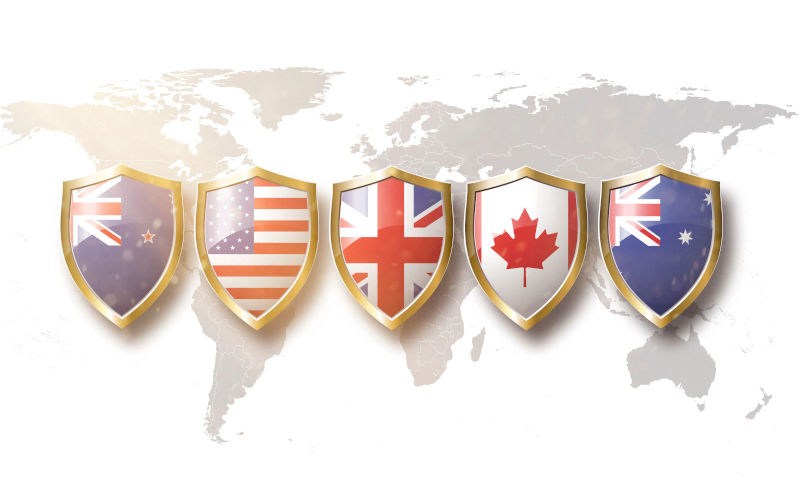
Australia is part of the white man’s intelligence network, Five Eyes. That means too much CIA input into anti-China perceptions in recent years. It also helped bring down the Whitlam government.
Five Eyes, the intelligence alliance between Australia, the United States, the United Kingdom, Canada and New Zealand was established in 1946. Today, we need to ask, who are the Five Eyes loyal to?
The Massachusetts Institute of Technology (MIT) Press has reported that in the 1980s British intelligence agencies accounted for eight per cent of the Five Eyes inputs, while the three smaller powers – Australia, Canada, and New Zealand – together contributed only about 2 per cent. A decade ago, the Australian expert, the late Professor Desmond Ball, estimated that the CIA provided 90 per cent of Five Eyes input. Since then, the gap has almost certainly widened, with US technological capabilities growing exponentially.
Not surprisingly, Australia’s picture of China and the world is thus substantially constructed by the US National Security Agency, CIA and Defence Intelligence Agency. Looking through its rear vision mirror, the US sees China rapidly catching up and mistakenly assumes that China will act as violently, just as the US has throughout its history. So when US agencies, with their jaundiced view of China, identify it as an existential threat, Australian analysts absorb that framing. Easily done!
Heavily influenced by the US, Australian intelligence agencies drove much of the China panic that started about a decade ago. As senior journalist Max Suich argued at the time, the pressure to rev up policy against the Chinese stemmed primarily from the Australian intelligence agencies, bolstered by Defence.
The avalanche of US intelligence stories hostile to China, via Five Eyes, was used in briefings to the anti-China hawks in our legacy media and US funded think tanks. These hawks know zilch about China but, having been on the Washington drip feed for so long, they were naturally at ease spruiking Washington/Langley propaganda about China.
Professor Wanning Sun has pointed to several key media episodes in telling the China panic story (World Scientific Connect, May 2026, What shapes Australian perception of China):
- In 2017 the ABC’s Four Corners warned us that China’s Communist Party was infiltrating Australia and in 2021, Sixty Minutes had a panel discussion ‘War with China: are we closer (to war) than we think’. In October 2022, Four Corners was at it again with a panel discussion that invited viewers to consider whether ‘it’s increasingly become a question of when, not if China will launch an assault on Australia’. The panel of ‘experts’ said it could come as early as 2025.
- In 2023, Peter Hartcher’s celebrated ‘Red Alert’ in The Sydney Morning Herald warned us that “Australia faces the threat of war with China within three years and we’re not ready”. This was accompanied by a large menacing image of Red China with black fighter jets attacking Australia. Paul Keating described the ‘Red Alert’ as “the most egregious and provocative news presentation of any newspaper I have witnessed in over 50 years in public life”. Paul Barry in Media Watch was even more pungent.
- Then we had Sky News in 2025 with War Cabinet, an exclusive event with Chris Uhlmann asking a ‘panel of experts’, are we ready for war with China. Mike Pezzullo, one ‘expert’, suggested that 2027 “could mark a likely Chinese invasion”. Peter Jennings, one of the other experts, who also featured in Red Alert, estimated the Chinese invasion might occur in the second half of this decade. How do these people keep their jobs?
Wanning Sun added: “Australia’s media do more than report on China – they help create the perception of threat itself. Through repeated warnings, dramatic imagery and predictive commentary, programs perform speech acts that make war imaginable, inevitable and urgent. This repetition entrenches fear in the public mind while commercial incentives ensure these stories dominate attention.”
Our legacy media and think tanks have accepted the anti-China framing supplied through Five Eyes by US agencies. This has also happened in Canada and elsewhere.
The Five Eyes helped drive the China panic in Canada in 2018. A report by John Price in Pearls and Irritations in 2024 revealed how US intelligence agencies and the Canadian Security Intelligence Service (CSIS) manufactured an inflated China threat in 2018 that mutated over the next five years to become Canada’s China panic, with far reaching implications:
The heads of the CIA FBI and other US intelligence agencies appointed by Donald Trump launched into what the Wall Street Journal called an unprecedented campaign in 2018 to portray China and the telecom giant Huawei as a major threat to the Five Eyes. Attending Five Eyes meetings in London and in Halifax, Canada’s CSIS director David Vigneault, who uncritically accepted the US accusations rushed to share them with Justin Trudeau in the spring and summer of 2018. Informed of US accusations the Canadian government willingly accepted the US request to extradite Huawei executive Meng Wanzhou.
In addition to the powerful US influence through Five Eyes, we also have Pentagon colonisation of our ADF. At the Australia–US Ministerial Consultations (AUSMIN) in 2023 it was agreed to establish a Combined Intelligence Centre–Australia (CIC–A) within Australia’s Defence Intelligence Organisation (DIO). The CIC–A will share DIO and the US Defense Intelligence Agency (DIA) intelligence. This is another of Richard Marles’ attempts to lock us into the most erratic, aggressive and violent country in the world. It seems he has also agreed that the US will have a veto on persons employed in ADF intelligence.
There is a Parliamentary Committee to oversee US-owned intelligence agencies, but MPs quickly become part of the intelligence club. This is known as regulatory capture. It is also reported that Richard Marles is proposing a similar committee to rally support for AUKUS. The Greens and Independents are to be excluded: they might ask serious questions!
I have personal insight into how US agencies operated in the downfall of the Whitlam Government. Prime Minister Whitlam appointed Justice Hope in 1974 to head an inquiry into intelligence/security services in Australia. In discussions with Hope, Whitlam suggested he should consider ways in which Australia might reduce its dependence on US intelligence/security agencies. But Hope had a love affair with ASIS. Quite improperly, he passed Whitlam’s suggestion to the Director General of MI6, Sir Maurice Oldfield, who then passed the information to Five Eyes, including importantly the US. That helped prepare the ground for the Whitlam dismissal.
The head of Defence, Arthur Tange, deceived Whitlam into thinking the Pentagon ran Pine Gap. Whitlam was furious when he learned that Pine Gap was in fact run by the CIA. He threatened not to renew Pine Gap’s lease and announced he would reveal CIA agents’ identities in Parliament. CIA East Asia chief Ted Shackley, with the approval of Henry Kissinger, then sent a telex to ASIO threatening to cut off the intelligence relationship unless ASIO provided a satisfactory explanation for Whitlam’s behaviour. That telex was circulated in Canberra and to Kerr. We know the rest!
Intelligence services have a view that they belong to a higher order, that they are better informed and more patriotic than others. In my experience they have a lot of information but very poor judgement. Moreover, organisations that operate in secret are prone to error.
It’s time we broke free from the US colonisation of our intelligence services. Gough Whitlam proposed that in 1974.

John Menadue is the Founder of Pearls and Irritations and a board member. He was formerly the Editor-in-Chief. John was the Secretary of the Department of Prime Minister and Cabinet under Gough Whitlam and Malcolm Fraser, Ambassador to Japan, Secretary of the Department of Immigration and CEO of Qantas.