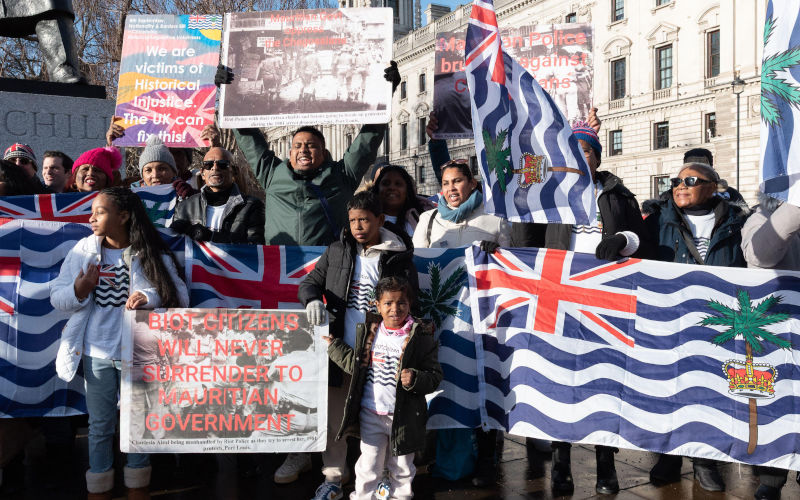
President Trump is reportedly wanting to buy the Chagos Islands from Mauritius as his way of securing control of Diego Garcia. First, the United Kingdom must hand back their sovereignty.
In late March, Iran fired two ballistic missiles from 3,800 km to the central Indian Ocean island of Diego Garcia. The US struck Iranian missile launchers from its military base there. Now President Trump wants to buy the strategic territory from the United Kingdom.
According to American, British and Israeli officials, one of Iran’s missiles broke apart during flight; the other appears to have been destroyed by US defences. Iran has denied responsibility for the launches, which until then were thought to be beyond its ballistic missile range.
British Prime Minister Starmer gave the United States permission for the strike from Diego Garcia; he was warned by Iran’s foreign minister against allowing the UK’s territory to be used for ‘aggression against Iran’.
Arguments over Diego Garcia, in the Chagos Island chain, have been going on for 60 years. Initially an Indian Ocean stopover port for Portuguese, Dutch and British sailors, the archipelago was taken over by the Dutch in 1638, who abandoned it in 1710. Plantation workers were brought from the Maldives, Seychelles, and a French possession called Île de France. Britain captured that from Napoleon in 1810 and renamed it Mauritius, which remained a British colony until 1968. Having initially denied that the Chagos Islands were inhabited – terra nullius — the United Kingdom, aware of the value of the Chagos archipelago’s fishing, oil, and mineral resources, excised its seven atolls with more than 60 islands from Mauritius in 1965, three years before the colony became independent.
The United Kingdom said it wanted ‘to use certain 10 islands for defence purposes’ and to ‘provide the land and security of tenure’ by putting them under British administration. London offered £3 million as compensation to 2,000 Chagossians it expelled between 1967 and 1973 from Diego Garcia to Mauritius, holding out the possibility of their return when their lands were ‘not needed for defence’.
Since 1971, Diego Garcia has been occupied by some 3,000 UK and US military and civilian contractors, and the Chagossians have not been allowed to return. In 2010, the British Government created a Marine Protected Area (MPA) more than twice the size of the United Kingdom, with fishing restrictions that do not apply to the US military, whose bases are accused of being a major source of pollution. That year, Mauritius launched proceedings against the MPA, which was determined to be illegal in successive judgments by international courts and tribunals.
In 2018, the United Kingdom apologised for its ‘shameful’ eviction of Chagossians in the 1990s and 1970s but sought bilateral discussions with Mauritius in preference to court proceedings. In the following year, the International Court of Justice (with only the American judge dissenting) said the United Kingdom was obliged to end its administration of the Chagos Islands as soon as possible. Labour leader Jeremy Corbyn condemned Prime Minister Theresa May’s defiance of the Court’s two rulings, both of which the American judge opposed.
After a discussion with President Trump, Starmer – a former human rights lawyer – eventually agreed to hand over British sovereignty of the Chagos Islands to Mauritius. The agreement was signed on 22 May 2025. But much of the British press called Starmer’s deal a disastrous sellout, and the legislation to give effect to it is still stalled.
The prime minister of Mauritius described the expulsion of the Chagossians as a crime against humanity. They still cannot return to reclaim Diego Garcia, which the United Kingdom continues to lease to the United States for an undisclosed amount for 99 years. A six-person delegation in London from the Chagos Refugees Group in the first week of June said the issue had been ‘hijacked’ by British politics.
Trump’s renewed interest in Diego Garcia is not just because it is another US base targeted by Iran. Chagos is part of the US Indian Ocean Island Chain, stretching from the Gulf of Oman to the Strait of Malacca, which provides refuelling and servicing bases for American warships and aircraft. Diego Garcia also has intelligence, communications and surveillance capabilities which are linked to Pine Gap in the Northern Territory.
The transactional president, having failed to annex Canada or buy Greenland, is reported now to be considering a ‘deal’ to purchase the Chagos Islands from Mauritius. That would enable him to eliminate British control, such as it is.
But the United Kingdom would first have to complete the process of ceding Chagos to Mauritius. Starmer might try to do that, enabling Trump’s purchase, whatever the outcome for the Chagossians. He is not in a good political position for such a ‘deal’. And Mauritius, as a member of the Global South, is closer to China than the United States and United Kingdom. China must be closely watching the Indian Ocean Chain, which joins the US-Japan-South Korea-Australia containment line around China.
Australia distinguished itself negatively in 2019 when, in response to an UN General Assembly resolution on Mauritius that 119 member states approved, it joined Hungary, Israel and the Maldives in supporting continued occupation of Diego Garcia by the United States and United Kingdom.
Not surprisingly, the Australian Government hasn’t said anything about Diego Garcia. Nor has Defence Minister Marles updated Australia on the runway extension that has been under way on Cocos Island for several years. It is also in the US Indian Island Chain. The Cocos and Keeling Islands, like Chagos, were British colonial territories. After a 150-year interregnum when the Clunies-Ross family ran them like a fiefdom, and – here’s the difference with Chagos – the Cocos people, whose ancestors had been brought there as plantation workers, voted for Australian administration.
One condition, according to Richard Woolcott, then head of DFAT, was that Cocos would not be used for military purposes. Times have changed, and more changes are likely.
Dr Alison Broinowski AM is a former Australian diplomat and a member of Australians fr War Powers Reform