Reducing the global population won’t stop global warming and, after temporarily overshooting 1.5oC, the world won’t return to what it was but we can still act to save our flora.
There can be little doubt that the combination of a historically very high global population and high average consumption per person is causing major environmental problems, including climate change. This is popularly expressed in terms such as humanity currently uses more resources than one Earth can sustainably provide. But unlike the British Royal Family, we don’t have a spare sitting in the wings. One way to reduce humanity’s environmental footprint, as Julian Cribb has concluded in Pearls and Irritations, is to reduce the global population.
It seems likely that, if the global fertility rate eventually stabilises at the rate required simply to maintain a stable population, the present population of around 8 billion will grow to around 12 billion by 2100 before plateauing at about 13.5 billion in 2200 (if humanity survives that long).
On the other hand, depopulation (the effective policy at present given declining fertility rates in many countries) might see the population peak at 10 billion in 2100 and fall to 7 billion by 2200. These two different, hypothetical, population trajectories would result in a 17 per cent difference in population size in 2100 and 90 per cent in 2200.
Would the lower populations make a significant difference to greenhouse gas (GHG) emissions and global warming? Emphatically not, according to US National Bureau of Economic Research. Despite the large differences in population size, the global temperatures are almost identical in 2100 and will differ by less than one tenth of one degree C. in 2200.
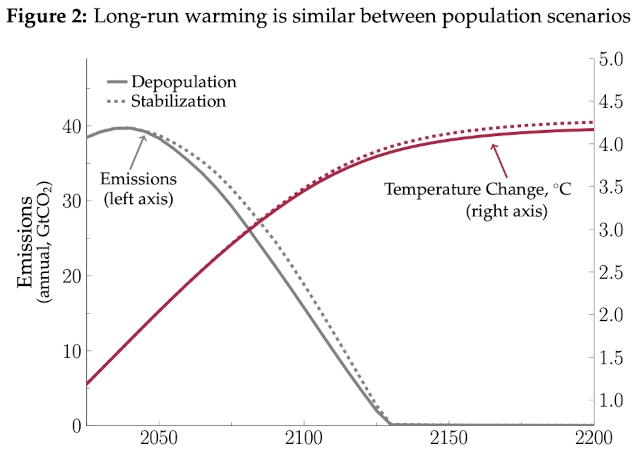
The authors add that if net-negative emissions technology (removal of CO2 from the atmosphere) becomes a reality, it is even possible that a smaller population will lead to marginally higher temperatures.
There are two main reasons for these superficially counterintuitive findings. First, fertility shifts take generations to substantially change population size and during that time per capita emissions of GHGs will decline significantly even under pessimistic policy assumptions. Second, it is the total amount of GHGs in the atmosphere that determines the level of global warming, not the level of annual emissions. Only a small share of humanity’s total historical emissions will occur after the many decades it will take for the population size to decrease substantially. Because of these two realities, the study’s results are robust to a wide range of modelling possibilities.
To be honest, what I find more worrying than the small difference in warming between the two population trajectories is that the level of warming projected for 2200 is around 4.2oC under both scenarios. It is totally impossible to know what the global environment will be like at that level of warming or how humanity will be coping. In one form or another, the planet will survive but will the human race?
None of this is to imply that there may not be good reasons to reduce the size of the global population, just don’t expect combating climate change to be one of them. (Advocates of a smaller global population are welcome to comment but please don’t shoot the messenger.)
Overshoot: ‘leaving the first best world behind’
You can only overshoot if you’ve got something to shoot at. As far as global warming is concerned, the Paris Agreement provided the world with that target in the form of limiting warming to the carefully worded ambiguity of no more than 1.5oC or 2oC (for simplicity, I’ll stick to 1.5oC).
Just to be clear though, there is no law of nature that defines warming of 1.5oC as an absolute boundary that must not be transgressed if humanity is to prosper or survive. 1.5oC is simply what negotiators agreed in Paris in December 2015 because they were all desperate to go home.
Warming overshoot became part of the public and political lexicon in the late twenty-teens when it became clear that it was unlikely global warming would be kept below 1.5oC. It describes the period between when the planet warms beyond 1.5oC and when it cools, either naturally or through human effort, below 1.5oC. By how much warming will exceed 1.5oC, for how long, the precise trajectory of overshoot and subsequent cooling, the likely environmental and social consequences of overshoot and exactly how cooling will be achieved remain unclear. We can’t even be confident that cooling will occur.
What is clear is that:
- Overshooting 1.5oC will occur in the next few years.
- Cooling will not begin until greenhouse gas concentrations in the atmosphere start to fall, which will occur only when emissions don’t just peak or even start to fall but are close to zero.
- Every tonne of greenhouse gas we pump into the atmosphere now will make the task of returning to under 1.5oC longer, harder and more costly financially, socially and environmentally. As the mantra goes, the more we do now, the less we have to do later.
- The inertia in climate systems, the global economy and political systems means that recovery from overshoot will not occur rapidly.
- The degree of overshoot and its consequences will be felt unevenly around the world.
- Should a return to warming below 1.5oC occur, the world will not be the same as it was before 1.5oC was exceeded. There will be considerable damage to the environment and to societies during the period of overshoot and some, possibly much, of the damage will persist, particularly if, as seems likely, environmental tipping points have been crossed. Species that have gone extinct will not miraculously reappear; ecosystems that have flipped will not revert to what they were. For example, a tropical rainforest that has become a dry grassland probably won’t regenerate for centuries, if ever.
- The hotter and longer the overshoot, the more likely it will be that, for instance, migration routes will be severed, fresh water sources will disappear and farming areas and rural communities will be destroyed by heat and droughts.
- The Earth Systems most likely to reach a tipping point around warming of 1.5oC are coral reefs, Arctic permafrost, the Greenland and West Antarctic ice sheets and the ocean currents around the poles (sub-polar gyres).
- At 2oC of warming, tipping points may well be crossed by mountain glaciers, boreal forests and the Atlantic Ocean’s currents (AMOC).
The challenges now are to limit the level and duration of overshoot and to plan its reversal. For instance: can we manage the cooling or will it be a chaotic fall? Who will lose access to land, water and livelihoods? Whose land will be used for nature-based solutions? Who will benefit? Who will decide? Will this become another form of colonial exploitation? And we need to do all that while not losing focus on mitigation, adaptation and responses to existing loss and damage.
The decisions we make now (particularly regarding fossil fuel extraction and burning, agriculture and diets, transportation and renewable energy) will determine the trajectory of overshoot and the conditions humanity will face for decades. Currently, politicians (focused on the next election) and the private sector (driven by this year’s share price, dividends and salary bonuses) are postponing the hard decisions that are needed to make deep cuts to emissions. How long can this go on?
In the words of Carl-Friedrich Schleussner, a research scientist, “We are leaving the first best world behind and are entering a second or third best world where we must manage the consequences of our insufficient actions”.
Or as Kate Raworth (Doughnut Economics, 2017) puts it, “Earth is the only planet we know that contains life. Holocene is the only period we know that can support human civilisation. We’re kicking ourselves out of the sweet spot.”
Melbourne’s new floral emblem
Here’s a nice touch, by gaining 17 per cent of a popular vote of Melbournians, the native but critically endangered swamp everlasting daisy has been chosen as Melbourne’s floral emblem. The swamp daisy will be planted in Melbourne’s parks, gardens and planter boxes and new Australians will receive them at their citizenship ceremony. A close second in the vote was the common billy button, also a daisy.
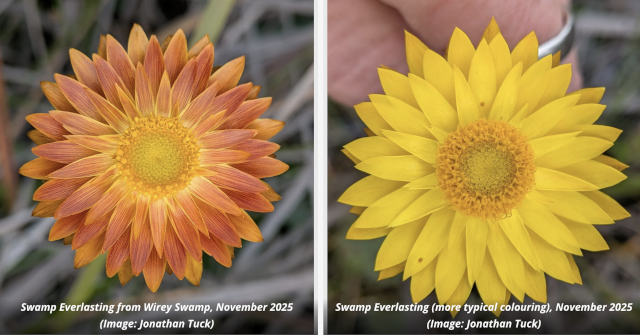
Swamp everlastings grow in shallow swamps and marshes and were once widespread in NSW, Victoria and Tasmania but the loss of wetlands, invasive species, grazing and climate change have restricted their range to about 35 scattered populations. A National Recovery Plan has been in existence since 2011.
Australia’s floral emblems
Finally, a little test. Darwin, Sydney and Brisbane, like Melbourne, have floral emblems that are not simply their state or territory bloomer. I won’t ask you to name those cities’ favourite flowers but can you name the floral emblems of our states and territories? I’ll give you some verbal and visual hints (and a red herring).
ACT: Royal ********
NSW: War ****
NT: Sturt’s ****** ****
Qld: Cooktown ******
SA: Sturt’s ****** ***
Tas: Tasmanian **** ***
Vic: Common (or Pink) *****
WA: Red and ***** ******** ***


Peter Sainsbury is a retired public health worker with a long interest in social policy, particularly social justice, and now focusing on climate change and environmental sustainability. He is extremely pessimistic about the world avoiding catastrophic global warming.