
Global warming is accelerating, extreme heat is already endangering lives in India, and Australia’s Safeguard Mechanism is failing to deliver meaningful emissions cuts from the country’s biggest industrial polluters.
Global warming has accelerated in last decade
The rate of increase in the global temperature has been pretty steady since the 1970s (about 0.2oC per decade). But there has been recent debate among climate scientists (sometimes with a whiff of acrimony) about whether the rate has taken a tick upwards in the last decade and what may have caused any change. The acceleration camp (most notably James Hansen) say, “it’s obvious, just look at the graph of global average temperatures, particularly the record annual highs”. The doubters want to see proof that any recent rate change is statistically significant and suggest that variations in natural rather than anthropogenic causes may be responsible for any change that does exist.
A recent study sought to tackle these issues head-on. First, the investigators removed the estimated influence of variations in the three main natural factors: the El Nino/Southern Oscillation (ENSO), volcanic activity and solar activity. Then they the compared annual average global temperatures statistically over the period 1970-2025.
To summarise the findings:
- Around 2015 the rate of warming per decade increased from about 0.2oC to 0.35oC (with over 98 per cent confidence in the finding).
- The rate of warming over the last decade is far higher than any decade since 1895.
- Global warming will exceed 1.5oC before 2030.
- It is likely but not yet proven that the cause of the acceleration is the reduction of aerosols (small particles of pollution from the burning of fossil fuels) in the atmosphere as a result of stricter air pollution controls. The particles reflect incoming solar energy and have had until recent years a general cooling effect on the Earth of about 0.4o
The authors conclude that this not unexpected accelerated warming “is a cause of concern and shows how insufficient the efforts to slow and eventually stop global warming under the Paris Climate Accord have so far been. Stopping this (accelerating) trend is in our hands: studies show that global warming will stop around the time humanity reaches zero CO2 emissions. In the current political climate, however, it is quite possible that warming may continue its fast pace or even accelerate further.”
Australia is clearly a major contributor to that risk. We are the world’s largest exporter of coal and one of the top three exporters of LNG. Fossil fuels extracted in Australia account for approximately five per cent of current global emissions of CO2. Domestically, Australia is the 14th highest emitter of greenhouse gases and we are one of the highest per capita emitters.
Let’s face it, when it comes to getting on top of climate change, Australia is a disgrace.
50 hottest cities in April all in India
On 27 April, every one of the world’s 50 hottest cities was in India. Most of the sweltering cities are in India’s central and northern interior, particularly the state of Uttar Pradesh with its 240 million inhabitants.
The average peak temperature across the cities on 27 April was 44.7oC; the warmest maximum was 46.2oC and the coolest maximum 41.9oC. The coolest minimum on the day was 29.1oC.
Humidity across the cities was low, in the 13-21 per cent range. At lower high ambient temperatures, low humidity facilitates sweating which lowers body temperature but when the ambient temperature is higher than body temperature (37oC), the body absorbs heat from the environment and no amount of sweating provides effective cooling. Heavy sweating does cause dehydration, however, leading to kidney stress and cognitive impairment.
As well as threatening public health, earlier and more intense summers in India are increasing peak power demand and affecting the economy, with estimates of extreme heating costing India 2.5-4.5 per cent of its GDP by 2030.
How hot is too hot?
It has been standard practice to regard exposure to a wet-bulb temperature of 35oC and above for six or more hours as causing irreversible harmful damage to humans, threatening survival, even though the full extent of the harm may not become obvious for several days.
A study of the health effects of six heat waves has, however, demonstrated that heat stress thresholds for humans are lower and drier than thought, particularly when individuals are exposed to the sun. In fact, extremely hot dry conditions are just as deadly as hot humid ones. Of potential concern to some P&I readers, the thresholds are lower for people over 65 years.
Somewhat reassuringly, simple strategies such as seeking shade and using mechanical cooling devices such as fans and air-conditioning dramatically reduce deadly heat stroke.
Australia’s Safeguard Mechanism – bipartisan climate policy in action
What follows is a story of bipartisanship in Australia’s climate policy. Unfortunately, it displays bipartisan obfuscation and a determination to let our biggest greenhouse gas (GHG) emitters continue to pump out global warming at will.
In 2015, the Coalition government introduced the Safeguard Mechanism. Very simply, under the scheme each of Australia’s largest approximately 200 industrial GHG emitters is required to reduce their net emissions annually, either by pumping fewer GHGs into the air or by purchasing offset credits to compensate for exceeding their maximum permitted level of emissions. In terms of reducing Australia’s GHG emissions, it was designed as a sham, operated as a sham and has achieved effectively nothing.
The Safeguard Mechanism is Australia’s largest and most costly policy for combating climate change, although it must be noted that it covers only the emissions produced at Australian production facilities, not the emissions produced elsewhere along a facility’s supply chain or when the facility’s products are used, mostly burnt. Around 55 per cent of the total onsite GHG emissions produced by the 200 facilities are related to fossil fuels and when these are burnt (mostly overseas) the emissions produced are around 15 times more than the onsite Australian production emissions.
On assuming government in 2022, Labor reviewed the Safeguard Mechanism (SM) and modified it. The first full year of operation of the revised scheme was 2023-24. Now, with two full years of operation, how is Labor’s modified SM going? Not well … not at all well.
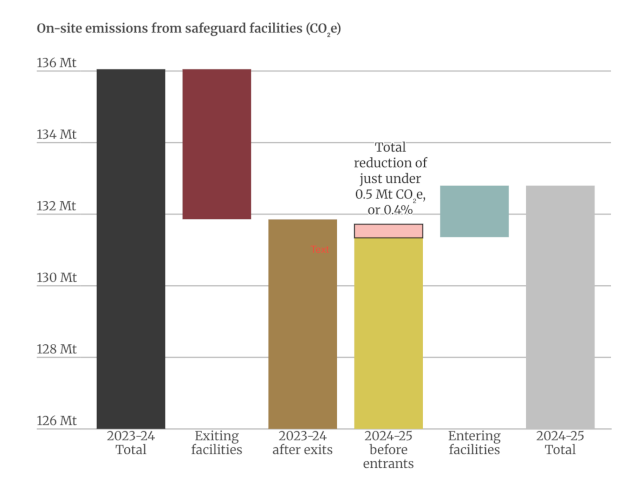
Total on-site emissions from the Australian facilities in the SM were approximately 136 million tonnes in 2023-24. In 2024-25 they were 133 million tonnes – a 2.4 per cent reduction. However, the vast majority of this reduction was accounted for by the net difference in emissions between those facilities that left the SM and those that entered it between 2023-24 and 2024-25. The aggregate emissions reductions of the facilities that continued in the scheme was just under 500,000 tonnes, a reduction of less than 0.4 per cent. These changes are displayed in the histogram below.
Between the first and second years of the reformed scheme, the use of offset units to compensate for the facilities’ excess GHG emissions increased by almost five per cent and demand for the emissions offset units in year two was 50 per cent greater than the government had projected. To make matters worse, the various sorts of projects that produce offset units (eg, planting trees, avoiding deforestation and use of gas from landfill) have been severely criticised for integrity problems and ongoing failure to deliver anywhere near the promised (and remunerated) reductions of levels of CO2 in the atmosphere.
The author of the report makes two very telling points:
- “The scheme is almost exclusively operating as a clearinghouse for low-integrity offset units and on-site emissions reductions are not occurring under the scheme in a meaningful way. Any public statements based on net emissions reductions under the scheme as determined by the aggregate of baselines are quite simply false.”
- “Those who would prefer to mute criticism of the Safeguard Mechanism are quick to point out that the heavy reliance on offsets over on-site emissions reductions is not evidence that the scheme is failing. They are correct. This is the scheme working precisely as it was designed. Rather than asking whether the reformed Safeguard Mechanism is failing, it is better to ask whether the scheme should have been designed to do more.”
The real tragedy is that this was all so predictable. In fact I dare say that the designers of the original and reformed schemes did predict it. But it was not in the interests of the governments of the day to declare the projected uselessness of their flagship policy.
Walking across lakes
I spent a week of my recent absence walking across the English Lake District on the first part of Wainwright’s Coast to Coast Path from St Bees to Robin Hood’s Bay.

English farmers have been endlessly inventive designing ways to allow humans but not farm animals to navigate fences and walls. Below is selection of some of the stiles and gates that I encountered.

Regrettably the absence of public footpaths across the countryside in Australia has relieved Australian farmers of any incentive to be innovative.

Peter Sainsbury is a retired public health worker with a long interest in social policy, particularly social justice, and now focusing on climate change and environmental sustainability. He is extremely pessimistic about the world avoiding catastrophic global warming.