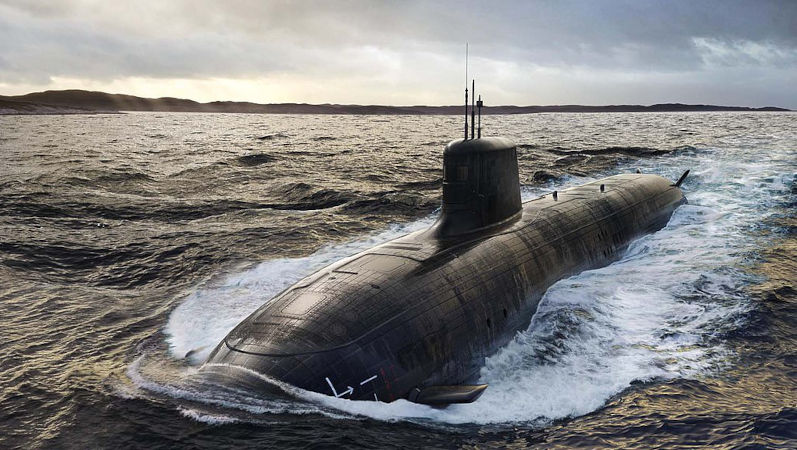
In the first of a two-part series, AUKUS is examined as a strategic choice, not simply a procurement program. The planned submarines are designed for US-led coalition warfare rather than a self-reliant defence of Australia.
Despite increasing risks to delivery of US and British nuclear-powered attack submarines (SSNs) under AUKUS Pillar One, the Australian government continues to express optimism that everything is ‘on track’.
As well as the delivery risks, however, there is mounting evidence that the US Virginia-class submarines and the British SSN AUKUS represent the wrong strategic and operational solution for Australia’s future undersea force posture. They will neither provide a capability that is fully under Australia’s strategic control nor one that is optimised for the self-reliant defence of Australia.
The AUKUS agreement signalled a major change in Australia’s strategic posture, reflected in Kurt Campbell’s comment about “getting Australia off the fence” in support of the US in its geopolitical contest with China. This was based on Scott Morrison’s judgement that Australia and the US have “an almost complete alignment of interests” in the Indo-Pacific and that China’s annexation of Taiwan would expose Australia to a threat comparable to the fall of Singapore in 1942.
By aligning Australia with US policy on Taiwan, Morrison was committing to sustaining US primacy to the extent of going to war. This was revealed following the AUSMIN meeting in Washington the day after the AUKUS announcement. A substantial increase in US force rotations through Australia, extending to all military domains, was announced, to deliver a strategy of ‘integrated deterrence’. A few weeks later, in response to a question about Taiwan, Defence Minister Peter Dutton said, “it would be inconceivable that we wouldn’t support the US in an action if the US took that action.”
In support of this strategy, Morrison wanted to acquire a fleet of SSNs for Australia that would be integrated into the US fleet. The AUKUS pathway, announced under the Albanese government in 2023, confirmed Australia would acquire US and British SSNs while the US would be provided with rotational basing facilities for its submarines on Australia’s west coast. This long-coveted base would provide the means for the US to exploit China’s major weakness in any conflict, identified euphemistically by Hu Jintao as the ‘Malacca dilemma’. Over 70 per cent of China’s oil imports are funnelled through the Malacca Strait chokepoint.
While the Albanese government subsequently sought to reset Australia’s relationship with China, which had descended to its lowest point in half a century, it did not deviate from the strategic posture adopted by Morrison and Dutton. This has created what former DFAT Secretary Peter Varghese calls “an unresolved tension” between Australia’s foreign policy, which “embraces a multipolar future where no country dominates”, and our defence policy which seeks “to ensure the retention of US strategic primacy”.
Morrison’s belief he had forged a “forever partnership” with America that would commit the US to Australia’s defence was naïve. As Henry Kissinger suggested, the US doesn’t do forever partnerships. Indeed, under President Trump, it has become even more apparent that Australia cannot rely on the US for our defence. Alone among major US alliances, the ANZUS treaty still contains no security guarantee. Indeed, Australia’s role as what one congressional representative calls America’s “beachhead” against China, makes it more likely we will be attacked, possibly, in the event of escalation, with nuclear weapons.
These risks to Australia’s security could be reduced by moving away from the strategy of ‘integrated deterrence’ in support of US primacy to one of greater self-reliance within the alliance. This doesn’t mean the agreement for the US to operate submarines out of Australia’s base at Stirling should be terminated. Consistent with standard international practice, however, any military operation launched from Australian bases should be subject to host country approval. The US should also be required to ratify the relevant protocols attached to the Treaty of Rarotonga, under which nuclear weapons cannot be stored in Australia nor nuclear attacks launched from Australian bases.
While we agree with Richard Marles that SSNs would provide “the single most important military platform that we can bring to bear” to defend Australia, AUKUS Pillar One will not deliver a self-reliant capability.
As Kurt Campbell indicated, Australia’s SSNs will be required to deploy as part of “the nearest allied fleet”. The purpose of a coalition force will not be to defend Australia but to assert the primacy of the United States. Australia’s SSNs will operate alongside US submarines that by 2032 will likely be nuclear armed and tasked to deliver a great power strategy of deterrence by punishment. At over 10,000 tonnes and embodying a major land attack capability, SSN AUKUS, in particular, is designed primarily for coalition warfare against a great power.
By contrast, expert opinion suggests the RAN would need around 12 submarines to deliver a credible strategy of deterrence by denial in the self-reliant defence of Australia. This requires more affordable, smaller and more nimble SSNs, optimised for ‘hunter killer’ operations in the congested waters to Australia’s north.
As discussed in Part 2, however, the major barrier to acquiring the AUKUS SSNs relates to Australia’s ability to provide responsible nuclear stewardship. Unlike any other nation’s SSNs, US and British submarines are powered by uranium enriched to the highest weapons-grade level of 93–97 per cent.
Michael Keating AC and Jon Stanford formerly worked together in the Department of Prime Minister and Cabinet when Dr Keating was Secretary.

Formerly Jon Stanford was a division head in the Department of the Prime Minister and Cabinet, a Partner in Deloitte Economics and a founding Director of Insight Economics.

Michael Keating is a former Secretary of the Departments of Prime Minister and Cabinet, Finance and Employment, and Industrial Relations. He is presently a visiting fellow at the Australian National University.