Australia champions Indigenous rights internationally, yet the militarisation of northern Australia raises urgent questions about consultation, consent and the use of Indigenous lands for defence purposes.
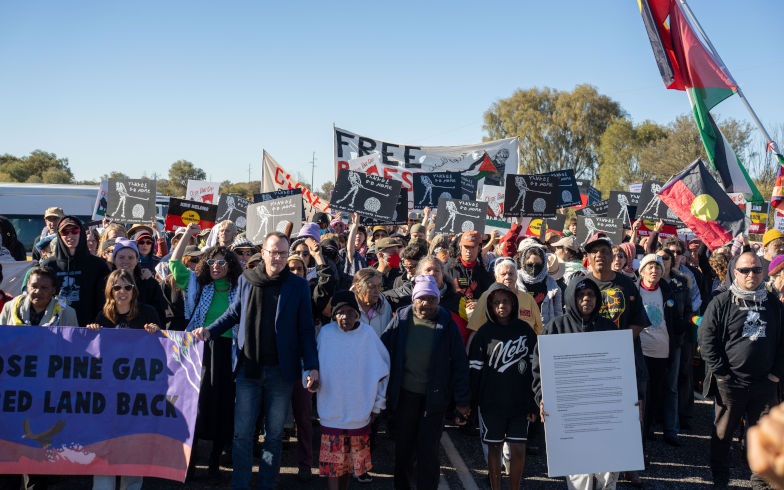
Last week a large group of protesters gathered outside Pine Gap, the United States / Australian Spy base 18 kilometres south-west of Alice Springs. It brought together locals and visitors from interstate. It was, by all accounts, the largest such gathering at the site since 1987 and it marked the 60th anniversary of the agreement which led to the founding of the base.
Many causes combined leading to calls for the base to be closed and the land returned to the Arrernte people. Traditional land owners delivered a letter of demand at the front gate. They had never been consulted about the development and the excision of land from their ancestral homeland. There was, as well, a particular emphasis on the presumed role played by the base in the ongoing wars in the Middle East and the genocidal violence perpetrated upon the Palestinians.
But Pine Gap represented much wider concerns. How was indigenous land ownership to be reconciled with the current drive of succeeding Australian governments to cooperate with United States plans to use the north of the continent to become the ‘central base of operations in the Indo-Pacific’ to what was described as ‘Chinese aggression?’ Defence Ministers Richard Marles and Pat Conroy show no reluctance to join hands with the Americans in the crusade to be what the Singaporean statesman Kishore Mahbubani called ‘the tip of the spear projecting Western power into Asia.’
But projecting power outwards will ensure it will be returned in kind. In any war with China Australian sites would inevitably be targeted. Pine Gap would be among the first and most important, significant enough to be hit with a nuclear missile.
Memories of the British nuclear tests inevitably surface again. The agreement to build Pine Gap was signed only a few years after the last tests were carried out at Maralinga. In neither case were the traditional Aboriginal owners consulted. As far as we can tell there has been no contemporary discussion with either Aborigines or Torres Strait Islanders, anywhere in north Australia, about plans for their country to be used as a central base of American operations to confront China and potentially fight what could inevitably be a catastrophic war.
But much has changed since the 1960’s both in Australia and in the wider world. Domestic politics has been transformed by the sudden emergence of Indigenous activism and escalating calls for land rights coming both from the cities and remote regions. The Mabo judgement transformed property law and all over the north of the continent the homelands movement saw a return of extended families and sometimes whole communities to live on country.
From Cape York in the east to the Kimberley in the west vast areas of land are now held by traditional owners as a result of restored native title, or in the Territory, as a consequence of the Land Rights Act of 1976 initiated by Whitlam and consummated by Fraser. In the Territory, around half the land mass and about 80 per cent of the coastline is now owned in perpetuity by traditional owners. It is territory over which communities exercise a sense of responsibility transcending European concepts of transient ownership. The remote ancestral past of the dreamtime is once again fused with the present and the endless future.
There is no indication at all that those people currently planning for the future role of Northern Australia in future wars, while investing vast sums in attendant infrastructure, have given any consideration to the views of the resident Indigenous communities whose country they are dealing with. In the case of the Americans it may simply be Imperial hauteur. The Australian defence planners still live with an inheritance which suggested that there is no need to take Indigenous opinion or sensibility into consideration when it comes to the serious business of administrative planning. And, as was so often the case, racial condescension runs like a little noticed underground current.
But in an era of accelerating decolonisation, old colonial habits will no longer do. The 21st century has seen a transformation in the international standing of the world’s Indigenous peoples, reflected in the UN General Assembly’s overwhelming adoption of the United Nations Declaration on the Rights of Indigenous Peoples in 2007. Australia initially voted against the Declaration under the Howard Government, but the Rudd Government formally announced Australia’s support in 2009. The Declaration was later embraced by Julie Bishop during her term as Coalition foreign minister: in 2014 she addressed the World Conference on Indigenous Peoples in support of its principles, and in 2015 reaffirmed Australia’s commitment to the Declaration at the United Nations General Assembly. Penny Wong has since taken up the banner, declaring that First Nations perspectives should be embedded in Australian foreign policy and appointing Australia’s inaugural Ambassador for First Nations People to carry that work internationally.
But international grandstanding is one thing. Domestic commitment is quite another. Australia has not incorporated UNDRIP into domestic law in any formal or comprehensive way, and its provisions were not made central to the public explanation of Indigenous rights during the Voice to Parliament referendum. Penny Wong’s Indigenous Ambassador, whose role is framed around international engagement, might have been more usefully deployed in Australia as well, explaining to domestic audiences which Indigenous rights Australia has formally endorsed.
This is particularly relevant to the little-known provisions relating to the use of Indigenous land for defence purposes. The preamble to the Declaration refers to the contribution of demilitarising Indigenous lands and territories to peace, development and friendly relations among peoples. Article 30 then goes further: military activities should not take place on Indigenous lands or territories unless justified by a relevant public interest, or freely agreed with or requested by the Indigenous peoples concerned. Article 30(2) requires states to undertake effective consultation with the Indigenous peoples concerned, through appropriate procedures and particularly through their representative institutions, before using their lands or territories for military activities.
What can one say? There is, as far as we can see, absolutely no intention of conducting any consultations anywhere in Northern Australia as the region is being prepared for war. And that is despite the endless repetition of Defence Minister Marles, both and home and abroad, that he is committed to a rules-based international order and Penny Wong’s declaration to the world that Indigenous rights stand at the forefront of Australian foreign policy. Hypocrisy, it seems, reigns supreme.
For First Nations Australia the way ahead requires a return to the past when an earlier generation of leaders took the fight for justice overseas. Queensland activist Les Malezer played a leading part in the drafting of the UNDRIP and introduced the completed document to the General Assembly. A return to the Human Rights Council in Geneva seems to be the only avenue to provide pressure on Australian governments to take Indigenous rights seriously.

Henry Reynolds is an eminent Australian historian.