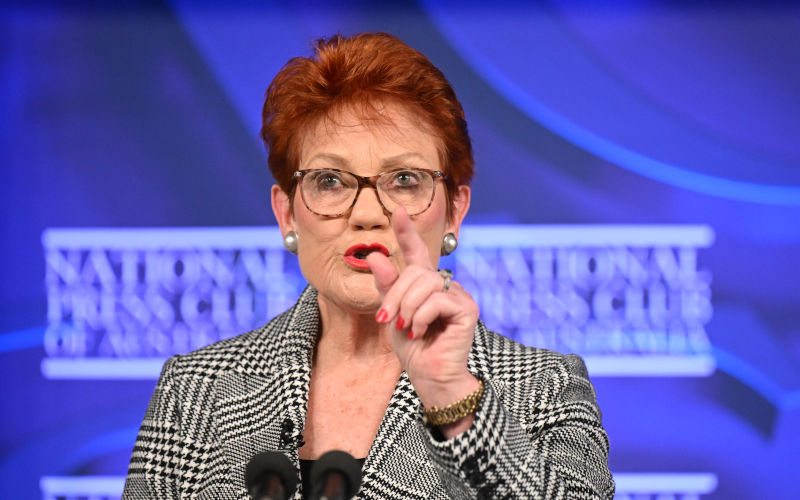
Pauline Hanson’s National Press Club address gave the media a chance to test One Nation’s claims on racism, public broadcasting, nuclear power, AUKUS, defence spending and foreign policy – but too many of the hardest questions went unasked.
Having spoken for longer than her allotted time at the National Press Club on 17 June, Pauline Hanson shrewdly co opted the podium by revealing One Nation’s intention in government, to abolish SBS, and to make the ABC a different, subscriber-funded organisation. She apparently wants to to boycott The Guardian as well.
If that gave the media a story, so did the sudden appearance of a large drop-down screen behind the president, Tom Connell. It asked them why the Senator had accepted a $100,000 pay rise while opposing a much lower wage increase for 2.8 million workers, proposed by the Fair Work Commission to take effect for Australians on minimum wages from 1 July.
No sooner was the panel torn down than GetUp! – which as a non-working media member couldn’t ask its question in person – was quick to claim the credit: ‘While Pauline Hanson was addressing the National Press Club for the first time in her 30-year career, we dropped a screen behind her’.
If the members were distracted by the stunt, they wasted the opportunity to put ‘gotchas’ to Hanson. Instead they concentrated almost entirely on domestic and identity politics and immigration, playing to Hanson’s strengths and long experience and to their owners’ vested interests. When she said One Nation was not racist, having in her prepared speech derided all Muslims, no-one picked her up with a ‘please explain’. When she said those seeking migration to Australia should first learn English, no question was put to her about xenophobia.
Hanson got away with deploring the cost blow-out of Snowy Hydro, politically attributing it to Malcolm Turnbull, even while One Nation courts Coalition preferences. She wasn’t challenged about her proposal of nuclear power for Australia and its much greater cost, when or if it would be delivered, or why it was needed at all as a substitute for the coal and gas that she wants completely to displace renewables.
What was most on display at the NPC was Hanson’s ignorance of world affairs, her lack of interest in them, and apparently that of the assembled media too. In her response to a lone question about Australia’s near neighbours, she derided Papua New Guinea and the money Australia wasted on it. Her Austro-isolationism may recently have been influenced by a visit to Mar-a-Lago, but her decades-old proposals for Australia to manufacture things instead of importing them revealed more about her MAGA-style aspirations than her understanding of the workings of protectionism and comparative advantage, let alone of the economic dominance of China.
There might have been no US/Israel-instigated war going on, for all the NPC and its ABC viewers heard from Senator Hanson about it. Nor the US-generated economic crisis affecting the whole world. Nor Israel’s genocidal assault on Gaza, the West Bank, and Lebanon. To ask her about Australia’s commitment to the predictably losing side of another illegal US war wasn’t important, evidently, for members of the NPC. But if she aspires to be prime minister in two years, her responses to these questions are what Australians need to hear.
Two inquiries into Antisemitism and into AUKUS might as well not be underway, for all the NPC members were interested in engaging Hanson about them. That the public AUKUS inquiry calls into question the ANZUS alliance, our unreliable US ally, and the sovereignty and security of Australia seemed not to occur to them as significant.
Nor did the media ask her about the current or future presence of nuclear weapons in Australia, and who controls their use. When she advocated nuclear power in the place of renewable energy, Hanson speculated that a plant might be built somewhere on the east coast, somehow financed by government and private enterprise. But she wasn’t asked about where or when it would be operational, about the transport and safe disposal of nuclear waste from it, or the waste from AUKUS either. If she had been, Hanson would have to have admitted she had no idea. Nor has the government.
The biggest information void left gaping by Hanson’s NPC appearance was about Australia’s defence expenditure. While she deplored wasteful government budgets and wanted less spent on the public service and selected social programs, she has called for the percentage we spend on the military to rise from just over two per cent to five per cent of GDP. NPC members didn’t ask about that, what it was for, and what it would do to deter an enemy, ingratiate an ally, or make Australia safer.
Instead, the NPC and ABC audience were left to imagine. Hanson emerged from her speech looking like an antipodean version of Donald Trump: long on identity politics, self-enrichment and isolationism, and short on regional collaboration and environmental sustainability. If One Nation is the preferred party in two years’ time, the major parties will have themselves to blame for imitating the worst of the US and none of the best. They should also look carefully at what appeals to Hanson’s supporters.
Dr Alison Broinowski AM is a former Australian diplomat and a member of Australians fr War Powers Reform